

 Română
 Français
 Deutsch
 Español
 Italiano
What does the "best dentist" in Cluj-Napoca mean for an arch without teeth?
When you are missing all the teeth on one arch, there is no single "best dentist" that works for everyone. There is a team that is right for your case. The right choice is made according to verifiable clinical criteria: a multidisciplinary team that assesses your bone, gums and remaining teeth together, planning based on 3D imaging and clear explanations about why a particular solution is being recommended to you. A ranking, a review or an advertised price cannot tell you these things.
The phrase "best dentist Cluj-Napoca" is one of the most frequent searches among patients preparing for a full-mouth rehabilitation. We understand it: it is a major decision, with an impact over many years. Still, no clinic can fairly claim that title, ourselves included. With this article we want to help you recognise for yourself, during the consultation, the signs of a serious approach.
Full-mouth rehabilitation (restoring all the teeth on one arch or on both) does not come down to a single medical procedure. It means a sequence of decisions: which teeth can still be kept, how many implants are needed and where they are positioned, which temporary restoration you will wear and what material the final restoration is made of. Each of these decisions belongs to a different specialty.
Why full-mouth rehabilitation requires a multidisciplinary clinic
A multidisciplinary clinic means that specialists from different fields analyse the same case and arrive at a shared plan. For an edentulous (toothless) or nearly edentulous arch this matters a great deal, because errors usually appear at the boundary between specialties. A well-inserted implant can be difficult to use prosthetically if it was not positioned from the start according to the future restoration.
The oral surgeon: extractions and bone preparation
The oral surgeon handles extractions, bone management and, where necessary, bone grafting procedures or sinus lift. The way an extraction is performed directly influences how much bone remains available for implants. You can find out more about this stage on the dental surgery in Cluj-Napoca page.
The implantologist-prosthodontist: the plan starts from the final teeth
In our practice, the plan starts from the result: where the teeth need to end up, what your smile line is, how your bite closes. Only then is the position of the implants established. The dentist who plans both the surgical part and the prosthetic part (the restoration itself) can link the two stages without compromises.
The endodontist and the periodontist: which teeth can still be saved
Many patients come to us convinced that "all the teeth have to come out". Sometimes that is true. At other times, an endodontist (the specialist in root canal treatment) or a periodontist (the specialist in gum disease) may determine that certain teeth can be saved. This assessment, made honestly, is one of the best signs that you are talking to a team and not to a single dentist who sees only one solution.
On the page about our clinic's team and approach you can see how the Dental Chic specialists work together.
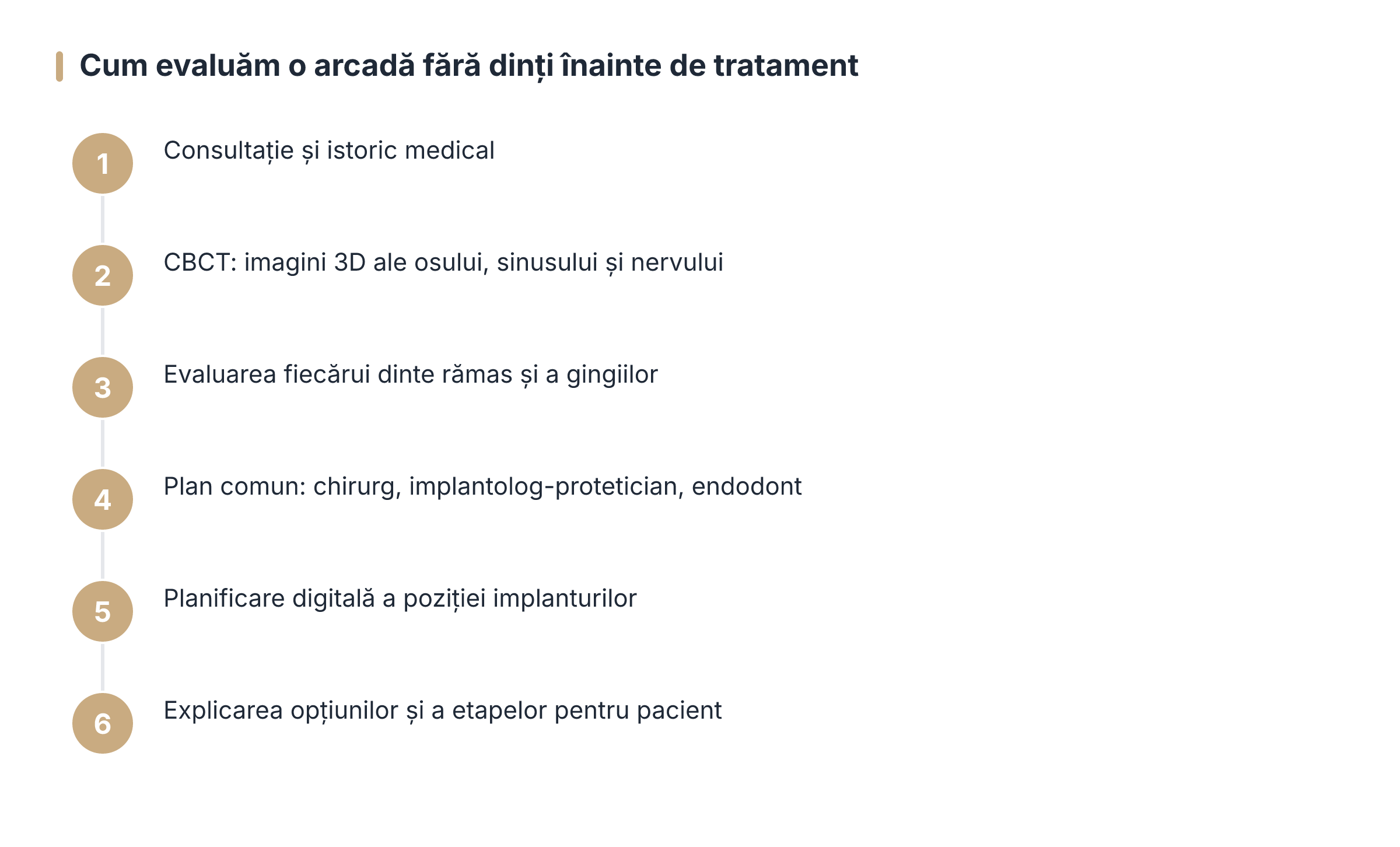
What a serious assessment before treatment must include
The first consultation for a full-mouth rehabilitation does not end with a price quote given after a quick look inside your mouth. A complete assessment includes several steps without which an implant plan cannot be clinically justified.
- Dental computed tomography (CBCT). This is a 3D scan that shows the height and thickness of the bone, the position of the maxillary sinus and the path of the mandibular nerve. Without it, the number and length of the implants are decided on estimates.
- Gum assessment. If you have active periodontitis, the inflammation must be brought under control before implants. You will find details on the page about periodontitis treatment.
- Analysis of the remaining teeth. For each tooth it is decided whether it will be kept, treated or extracted, with the reason explained.
- Medical history. Diabetes, osteoporosis medication, anticoagulants or smoking change the plan and the pace of treatment.
- Digital planning. Based on the 3D images, the position of the implants is simulated before the procedure.
If at the end of the consultation you understand why that particular solution was recommended to you, the assessment has done its job.
All-on-4, All-on-6 or individual implants: how the decision is made
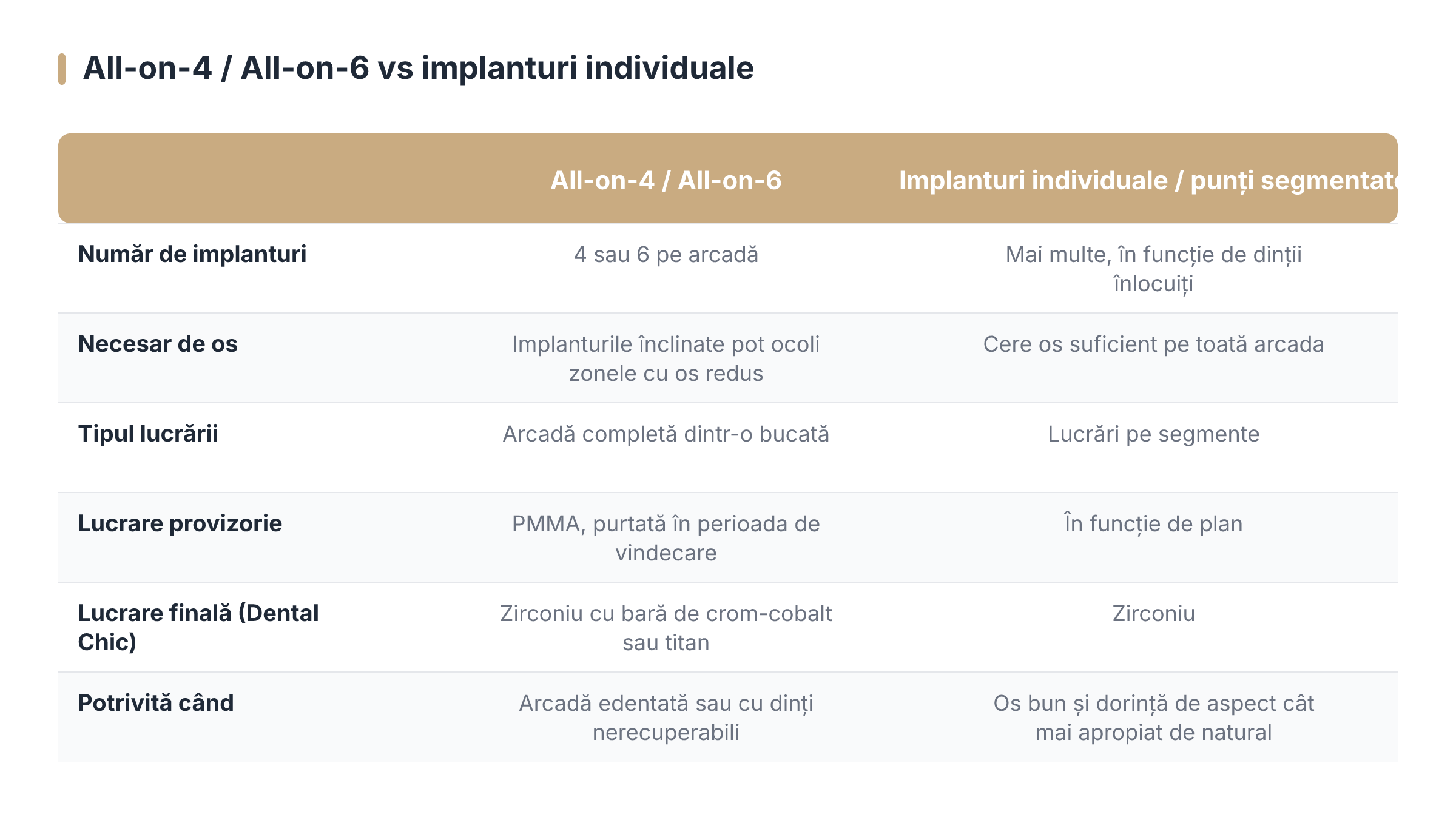
Patients often come in with a fixed idea about treatment, usually "I want All-on-4". The right recommendation, however, depends on the bone, the bite and your expectations. As a guide, there are three main directions.
- All-on-4: a complete arch of fixed teeth supported by four implants. The rear implants are usually tilted to avoid the sinus or the nerve, which can reduce the need for bone grafting.
- All-on-6: the same idea, with six implants. Chewing forces are distributed more evenly, and this option is preferred when the bone allows it, especially in patients with a strong bite.
- Individual implants or segmented bridges: more implants, with the restorations divided into segments. They can reproduce the appearance of natural teeth more faithfully, but they require sufficient bone across the whole arch and a longer treatment.
On the page dedicated to All-on-4 and All-on-6 fixed teeth you will find the full description of these solutions.
Which materials we use and why
In our clinic we work with Straumann, Nobel Biocare or Bredent implant systems. The temporary restoration, worn during the healing period, is made of PMMA, a lightweight acrylic resin that is easy to adjust. For the final restoration we use only zirconia, reinforced with a chrome-cobalt bar (the standard option) or a titanium bar (the premium option). We chose this approach after seeing, over time, fractures in final restorations made of composite. Reinforced zirconia gives us the strength that a complete arch taking on all the chewing load needs.
The questions worth asking at your consultation
The most useful tool when choosing a dental clinic in Cluj-Napoca is a set of good questions. Here is what we recommend patients ask, wherever they go:
- Who performs the extractions, who places the implants and who makes the restoration? Do they consult each other?
- Has each of my remaining teeth been assessed? Why is this one being extracted?
- What is the proposed number of implants based on? Can I see the 3D images?
- What implant system do you use?
- What temporary restoration will I wear and for how long, and what material is the final restoration made of?
- What are the stages, how long does each one take and what check-ups follow after completion?
- Can I see cases similar to mine, documented by your team?
The last question matters a great deal. Documented cases, showing the starting situation and the final result, say more than any description. On our page of clinical cases from Cluj-Napoca you can see rehabilitations carried out in the clinic.
When fixed teeth are not yet the right solution
A serious team will also tell you when you need to wait. Uncontrolled diabetes, an active infection, untreated periodontitis or certain medications may mean postponing the implants or carrying out additional preparation. Heavy smoking increases the risk of complications around implants, and we discuss this openly with every patient.
Sometimes, for medical or personal reasons, a well-made removable denture remains a reasonable stage until a fixed solution becomes possible. We do not consider this a failure. It is a decision adapted to the patient.
If you would like to find out what options you have in your situation, the first step is a complete assessment. You can reach us on the contact and appointments page.
Frequently asked questions
How can I tell whether a clinic has experience in full-mouth rehabilitations?
Ask to see documented cases similar to yours, with the initial situation and the final result. Ask who takes part in the plan and whether the specialists consult each other. Then watch whether the reason for each recommendation is explained to you: why a particular number of implants, why one tooth or another is extracted. An experienced team can justify every decision on the basis of the 3D images and the examination, not just on a general impression.
Do all my teeth have to be removed for All-on-4 or All-on-6?
Not always. All-on-X solutions replace an entire arch, so the remaining teeth on that arch are usually extracted. Before that, however, we assess each tooth. If several teeth can be saved, there may be options that keep them, for example individual implants or combined bridges. The decision is taken after the examination, the CBCT and an open discussion about the advantages and limits of each option.
Is All-on-6 better than All-on-4?
Neither is superior in every situation. All-on-6 distributes chewing forces across more implants and we prefer it when the bone allows, especially in patients with a strong bite. All-on-4 uses tilted implants in the posterior area and can avoid bone grafting when there is limited bone. The recommendation depends on the bone volume, the anatomy and the forces the restoration will have to take on.
Why do I get a temporary restoration first and not the final one?
Implants need time to integrate into the bone. During this period you wear a temporary restoration made of PMMA, a lightweight resin that is easy to adjust as the gum heals and its shape changes. The final zirconia restoration, reinforced with a chrome-cobalt or titanium bar, is made after healing, so that it fits precisely on the stabilised tissues.
Can I have the treatment if I live in another country?
Yes, many patients living abroad have their rehabilitation done with us, and the stages are planned around their visits to Romania. The initial assessment and the imaging make it possible to set a realistic timeline, covering the procedure, the healing period with the temporary restoration and the fitting of the final restoration. Between visits we stay in touch for any questions, and check-ups are scheduled to coincide with your trips home.
This article is for information purposes only and does not replace a specialist consultation. For a diagnosis and a personalised treatment plan, please book an appointment.