
TREATMENT

Dental crowns Cluj Napoca

Dental crowns Cluj Napoca
01

What is a dental crown?

inlay onlay Cluj, obturatii estetice

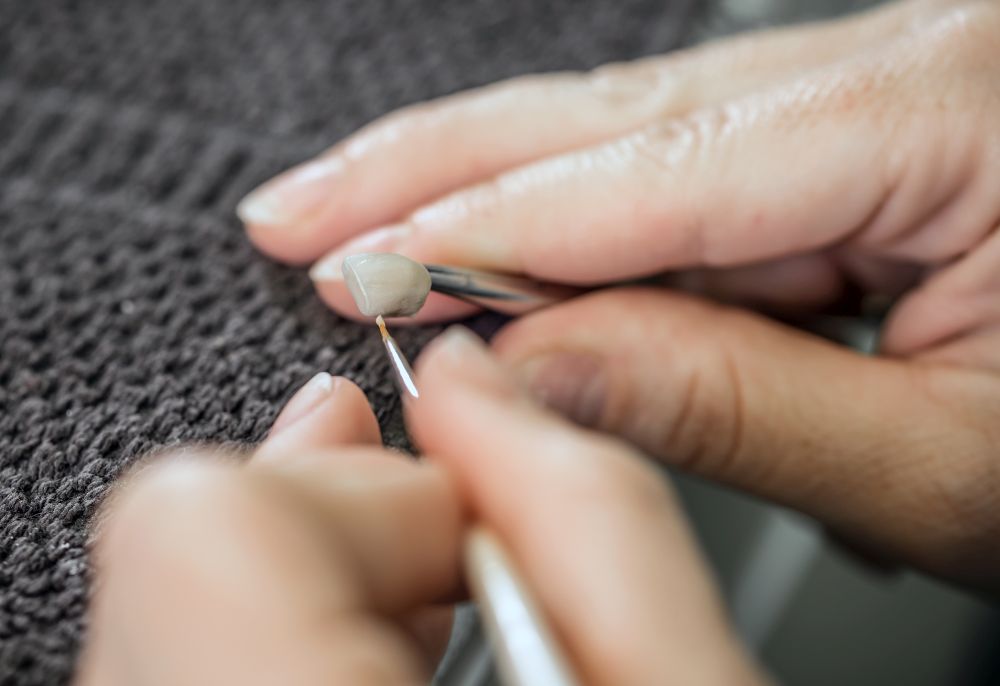
A dental crown is a covering that aims to completely restore a damaged tooth. It can be cemented onto the surface of a natural tooth or cemented or screwed onto a dental implant, but it can also be part of a prosthetic restoration such as a dental bridge, replacing a tooth. Once cemented or screwed, the dental crown completely covers the visible part of the tooth, up to the gum line.


02

When is a dental crown necessary?

The dental prosthetics specialist may recommend the implementation of such prosthetic restorations in the following cases:

  • To protect a damaged and weakened tooth, as is the case with devitalized teeth, to avoid it from cracking and breaking;
  • To restore a tooth that is already cracked or broken following severe trauma;
  • To cover and protect a tooth severely affected by decay, whose walls can no longer be restored with composite;
  • To replace a tooth with a dental bridge;
  • To cover a dental implant;
  • To change the appearance of a tooth.

Questions about this treatment?

0743 444 333Book online
03

Types of dental crowns

inlay onlay Cluj, obturatii estetice

Dental crowns can be of several types, depending on the type of material and the purpose for which they were made. We frequently encounter the question "how many types of dental ceramics are there and which is the best crown?". Below we will detail by purpose, material and attachment method.

Types of dental crowns depending on purpose

  • Onlay – this type of dental crown partially covers the tooth, making it the ideal alternative for large fillings.
  • Temporary or provisional dental crowns – these works are used in the intermediate stages of dental restorations, having an aesthetic role, helping with chewing and protecting the polished teeth, and are usually made of composite or acrylic.
  • Permanent dental crowns – represent the final restoration of the tooth, completely covering the tooth. They can be made of various materials and combinations of materials depending on the patient's wishes, but also the needs of the case.

Depending on the material used, dental crowns can be of several types:

  • Metal-ceramic dental crown – is very resistant, with ceramic layers being applied over a metal framework. Metal crowns rarely deteriorate, being the most durable. Due to the metal structure, which is most often visible, they are generally used for molars or teeth that are not visible during speech.
  • The ceramic dental crown on a zirconium support or entirely made of zirconium – is very similar to the metal-ceramic one, especially in terms of resistance. Dental zirconium is a hard material, which can be successfully used for teeth in the back of the dentition. The major difference is the superior aesthetics that zirconium offers, being available in various shades close to those of the natural tooth.
  • All-ceramic crown – represents the most aesthetic variant of dental crown. The material used is biocompatible, translucent, the result being almost indistinguishable from a natural tooth. Generally, these dental crowns are used for front teeth.
  • Composite dental crown – is the least recommended solution in terms of strength and durability, however, for certain patients who are very sensitive to both metals and porcelain, composite crowns may be the right restoration option. Composite is suitable for temporary dental work or as an intermediate option for patients who have a high rate of tooth decay.
  • Acrylic or metal-acrylic dental crown – currently, acrylic crowns are indicated and used only for temporary restorations. An acrylic or all-acrylic crown is generally used when some work needs to be temporarily hidden or to help the patient speak and eat normally until temporary teeth are placed following a dental implant treatment. The metal-acrylic crown is much more resistant and offers more advantages, being more often used in dental prosthetics.

Depending on the method of attachment, dental crowns are of several types:

  • Dental crown on a single tooth (stabilized on an existing tooth with or without a dental post, depending on the situation);
  • Dental crowns unified into a dental bridge (which can be mounted on existing teeth or implants, depending on the case);
  • Dental crown on implant attached by cementation or screwing. Discover the differences between the two types of attachment.
04

Where is a dental crown made?

Dental crowns can be made in the laboratory by a dental technician or directly in the dental office by the prosthodontist, using CEREC 3D Cad/Cam computer technology.

  • The dental crown made in the laboratory is made based on the impression taken by the prosthodontist in the office, which will be transmitted to the dental technician. In the case of this type of dental crown, several visits are required until the work is completed for tests and adjustments if necessary. The crown made will meet the aesthetic and functional needs of the patient. These crowns are ideal for front teeth, since, being handmade, they can capture the physiognomy and natural peculiarities of the tooth.
  • The CEREC all-ceramic dental crown, made computer-aided using Cad/Cam technology, has the primary advantage of being fast. The Cerec crown is made in a single visit, right in the dental office. The impression is obtained digitally by scanning the entire dentition, which eliminates possible errors. The milling machine then makes the dental crown from a ceramic cube, a biocompatible and translucent material, which gives the future prosthetic restoration a very aesthetic appearance, difficult to distinguish from a natural tooth.
05

How is a dental crown made?

To create a permanent dental crown in the laboratory, several steps and visits to the dental office are required. In the case of an all-ceramic or zirconia CEREC dental crown, the creation can be done in the same session, with the help of computer-aided prosthetics and a special milling cutter.

The first step, if the tooth has not received root canal treatment, is a panoramic x-ray to assess the condition of the tooth. Local anesthesia is performed and the surface of the tooth is ground to create the necessary space for the dental crown. Depending on the type of crown chosen, made in the laboratory or computerized CEREC Cad/Cam, the prosthodontist takes an impression of the tooth (traditional or digital in the case of CEREC) on the basis of which the final work will be made.

06

How long does a dental crown last?

The durability of dental crowns depends greatly on the type of materials used, the patient's bite, and, above all, the care the patient takes with oral hygiene. Metal-ceramic crowns tend to last a much longer period due to the metal skeleton inside, while all-ceramic crowns, although offering much better aesthetics, cannot withstand the same chewing forces. Howeveri, ceramic crowns on a zirconium support offer outstanding aesthetic results and have very high resistance.

Our doctors

Dr. Adrian Constantinov

Dr. Adrian Constantinov

Implantology & Dental Prosthetics

Dr. Roxana Balan

Dr. Roxana Balan

Dento-Alveolar Surgery

Dr. Veronica Constantinov

Dr. Veronica Constantinov

Dento-Alveolar Surgery & Implantology

Dr. Radu Bulat

Dr. Radu Bulat

Endodontics under the microscope

Prices

Zirconia crown1.500 RON
All-ceramic crown1.500 RON
Metal-ceramic crown1.200 RON
Zirconia crown on implant1.800 RON
Metal-ceramic crown on implant1.400 RON
Provisional aesthetic crown made in the laboratory, per unit220 RON

See the full price list

Frequently asked questions

What is a dental crown?
A dental crown is a covering that aims to completely restore a damaged tooth. It can be cemented onto a natural tooth, cemented or screwed onto a dental implant, or be part of a dental bridge. Once fixed, it completely covers the visible part of the tooth, up to the gum line.

When is a dental crown necessary?
The doctor may recommend a crown to protect a weakened or devitalized tooth, to restore a cracked or broken tooth, to cover a tooth severely affected by decay, to replace a tooth with a dental bridge, to cover a dental implant, or to change the appearance of a tooth.
What materials are dental crowns made of?
Crowns can be metal-ceramic, ceramic on a zirconia support or entirely made of zirconia, all-ceramic, composite or acrylic. All-ceramic crowns are generally used for front teeth, while acrylic crowns are used only for provisional restorations.
How long does a dental crown last?
Durability depends on the type of materials used, the patient's bite and oral hygiene. Metal-ceramic crowns tend to last longer due to their metal framework, while ceramic crowns on a zirconia support offer good aesthetic results and high resistance.

In the press

ROmedicBusiness InsiderInternaționalAntena 3 CNNAssociated Press (AP)InternaționalAntena 1StreetInsider.comInternaționalLibertateaIPS Inter Press ServiceInternaționalClujul de AziWashington City PaperInternaționalJurnalulTimes of San DiegoInternaționalZiar de ClujNewsBreakInternaționalKanal DBig News NetworkInternaționalB1 TVThe Chronicle JournalInternaționalTVRTVR InfoNaționalulAdevărulGSP Gazeta SporturilorCanCanVIVA!ELLEEuroMedic.roSpotmedia

Schedule a consultation at Dental Chic Cluj-Napoca

Talk to a doctor on our team about the treatment options for your case, without pressure and with a written plan at the end.

Talk to a specialist