We could not send your request. Call us at 0743 444 333 or write to us on WhatsApp.
Thank you! We will call you shortly.
01
Types of orthodontic conditions that can be treated with braces:
Malocclusion – incorrect alignment of the teeth in the arch and the jaws in the contact area (bite)
Crowded teeth
Teeth with very large spaces between them
Teeth rotated from their normal axis
Teeth located too far forward or too far back from their normal position in the dental arch
Diastema/trema ("gap"), the space between the two central front teeth
Closing post-extraction spaces to avoid dental work
Bringing permanent teeth stuck in the bone into the arch
02
What is a dental brace?
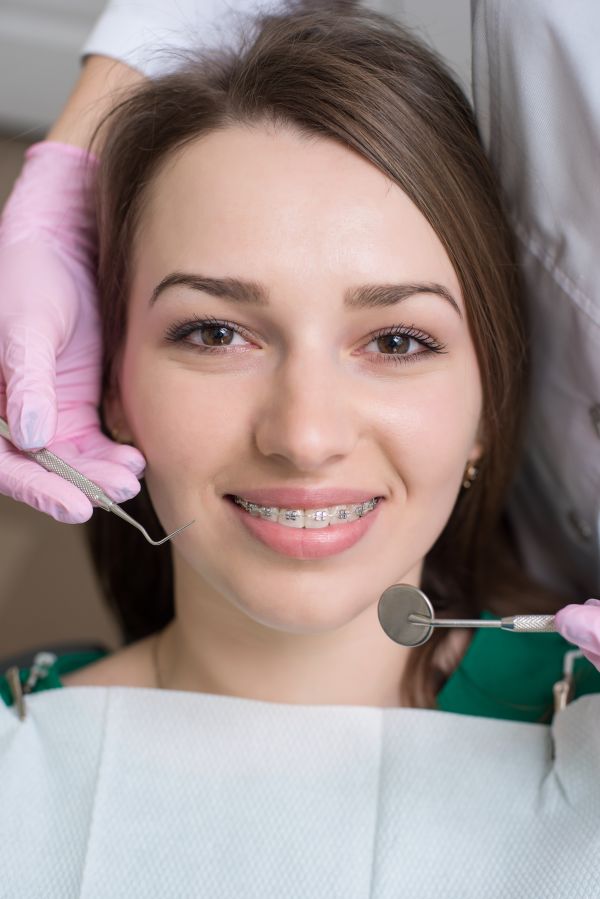
The dental appliance corrects dento-maxillary anomalies that appear on the dental arches with permanent teeth. Wearing it represents, first of all, the solution of a functional and then aesthetic need. Its role is to help reposition the permanent teeth so that you can achieve not only a beautiful smile, but also a healthy one. It is known that aligned teeth are much easier to clean, do not favor the appearance of dental caries and cannot fracture due to improper position.
Orthodontic treatment with braces not only helps improve the functionality of the smile, but you can also see the impact it has on the overall appearance of the face from the first weeks, restoring its symmetry and aesthetics.
Dental braces are the safe solution that saves teeth incorrectly positioned on the dental arch and unsightly interdental spaces, works to straighten teeth and at the end of orthodontic treatment the patient will have the desired smile.
The orthodontist is concerned with both the functionality and beauty of the smile, as well as the overall harmony of the face. Therefore, each treatment plan is unique and personalized.
Benefits of wearing braces:
Corrects misaligned teeth and unsightly interdental spaces
Corrects malocclusion
Improves the functionality and aesthetics of the smile
Improves mastication
Correctly positioned teeth evenly distribute chewing forces, avoiding excessive wear on certain teeth.
Prevents joint pain and dysfunction
Increase self-esteem by providing an aesthetic smile
Why is it important to wear braces?
Orthodontic treatment with braces not only helps you improve the functionality of your smile, but you will notice from the first weeks the impact it has on the overall appearance of the face, restoring its symmetry and aesthetics. Braces correct an anomaly such as crowding of teeth in the arch, large interdental spaces, etc.
The orthodontist is concerned with both the functionality and beauty of your smile, as well as the overall harmony of your face. That's why your treatment plan is unique, personalized just for you.
A dental brace is a device that applies pressure to the patient's teeth to achieve their alignment in the desired direction, after a certain amount of time.
Who and when can seek orthodontic treatment?+
People with tooth positioning problems can wear braces at almost any age. However, the ideal period is between 10 and 14 years old, as the bone tissues of the head and mouth are still developing.
How long does a braces treatment last?+
The duration of orthodontic treatment depends on several factors, but if the patient's situation is complex, they may wear braces for up to 2 years. In most cases, orthodontic treatment lasts more than a year.
Does wearing braces cause pain or discomfort?+
Orthodontic treatment involves a monthly visit to the dentist's office, at which time the orthodontist will change the pressure of the brackets depending on the progress observed. This may sometimes involve slight discomfort in the teeth and arches after each visit, but this will not be long-lasting.
Are there any invisible braces?+
If you want invisible braces, you can use lingual braces or special Invisalign aligners. Lingual braces are mounted on the inside of your teeth, and Invisalign aligners are transparent. This way, no one will notice that you are wearing braces. You can also opt for sapphire brackets, which are very aesthetic and discreet.
What foods can I eat during orthodontic treatment?+
While wearing braces, it is advisable to avoid sweets, acidic drinks and very hard foods, as they can damage your teeth and gums and can weaken or even break your orthodontic device.
How should I brush my teeth when I wear braces?+
The orthodontic appliance has spaces that can easily retain food debris and thus bacterial plaque can form. It is advisable to brush your teeth carefully after each meal with a fine-bristled toothbrush, then rinse your mouth with plenty of water and check in the mirror if you have perfectly cleaned your teeth and the appliance.
04
Types of dental braces
Orthodontics is a branch of modern dentistry that deals with the prevention, diagnosis, and treatment of certain dental and facial bone conditions and abnormalities with the help of dental appliances.
Who performs orthodontic treatments?
Dental treatment with the help of orthodontic appliances can be performed exclusively by a specialist in Orthodontics and Dento-Facial Orthopedics. The orthodontist follows another 3 years of training in orthodontics after graduating from the faculty of dentistry, during which he sediments his knowledge related to the correct realignment of the teeth in the arch, about how to ensure the correct development of the jaw bones through specific methods using several types of fixed dental appliances.
Removable dental appliances – for children between 7 and 12 years old, when permanent teeth begin to appear in the wrong position. It can also correct the shape of deformed jaws, for example, after sucking a finger, bottle, etc.
Fixed dental braces – for children and adults – which stick to the outer surfaces of the teeth:
Metal braces
Ceramic braces
Sapphire braces
Invisible braces: they are mounted on the inner surface of the teeth and are not visible (unlike the classic ones):
People with tooth positioning problems can wear braces at almost any age. However, the ideal period is between 10 and 14 years old, as the bone tissues of the head and mouth are still developing.
How long does a braces treatment last?+
The duration depends on several factors. If the patient's situation is complex, braces may be worn for up to 2 years, and in most cases orthodontic treatment lasts more than a year.
Does wearing braces cause pain or discomfort?+
The treatment involves a monthly visit to the practice, at which time the orthodontist adjusts the pressure of the brackets depending on the progress observed. A slight discomfort in the teeth and arches may appear after each visit, but it does not last long.
Are there braces that cannot be seen?+
Yes. Lingual braces are mounted on the inside of the teeth, and aligner trays are transparent. You can also opt for sapphire brackets, which are aesthetic and discreet.
How should I brush my teeth when wearing braces?+
The orthodontic appliance has spaces that can easily retain food debris, favoring bacterial plaque. It is advisable to brush your teeth carefully after each meal with a fine-bristled toothbrush, then rinse your mouth with plenty of water and check in the mirror that your teeth and the appliance are clean.


 Română
 Français
 Deutsch
 Español
 Italiano