

 Română
 Français
 Deutsch
 Español
 Italiano
What happens at the first consultation for dental implants?
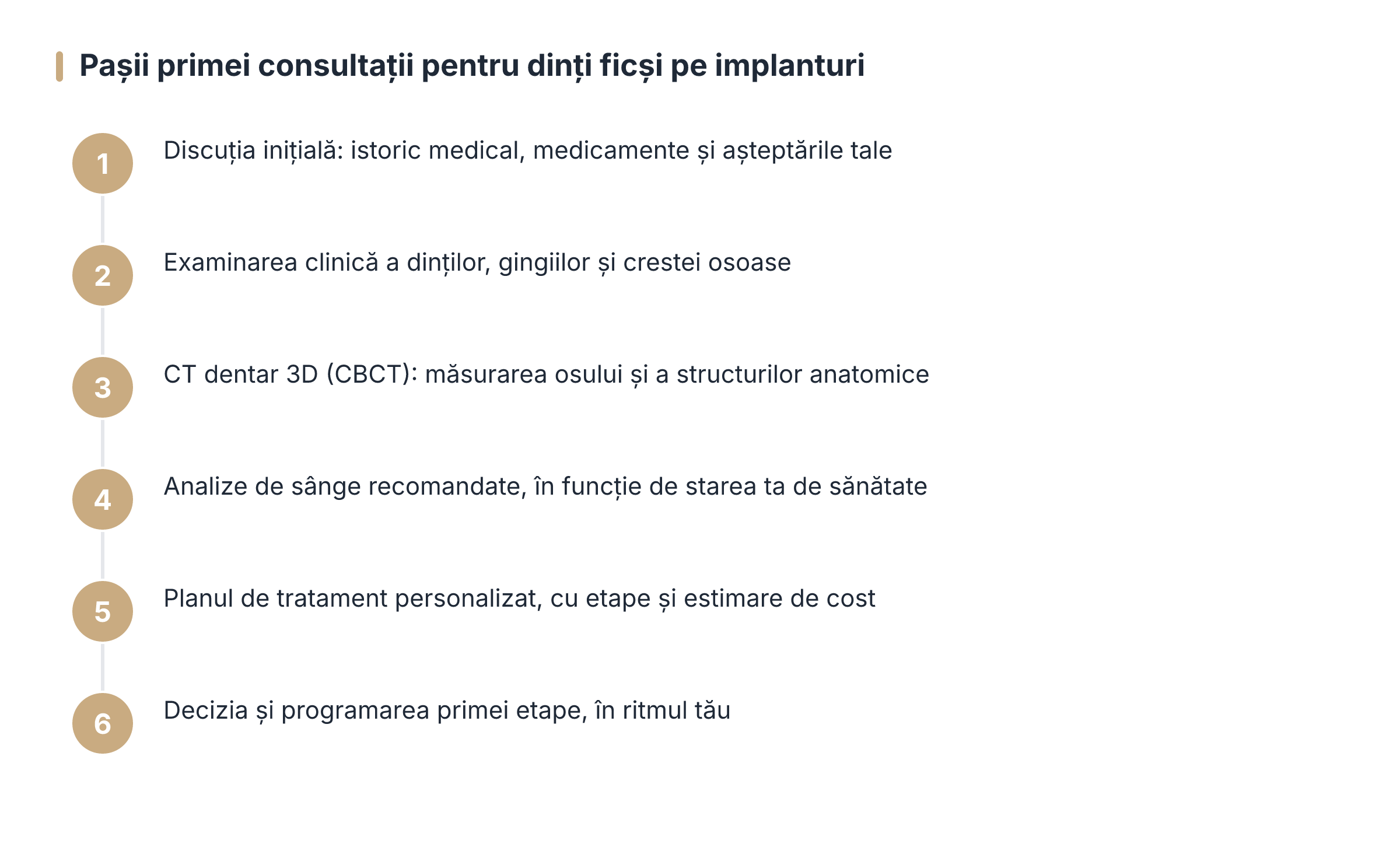
The first consultation for fixed teeth on implants generally lasts 45-60 minutes and includes a detailed discussion of your medical history, a clinical examination of your mouth, a 3D dental CT scan (cone beam computed tomography) and, at the end, the outline of a personalised treatment plan. The dentist may also ask for routine blood tests, especially if you have chronic conditions or are taking regular medication. By the end of this visit you know which solution suits you, how many stages it involves and what the estimated cost range is.
At our clinic in Cluj-Napoca, this first dental implant consultation is the moment when we lay the foundations of the entire treatment. For patients with no remaining teeth or with many compromised teeth, who are considering a fixed set of teeth of the All-on-4 or All-on-6 type, the initial consultation matters even more: this is where we determine whether the bone allows the implants to be placed, how many implants are needed and what the final restoration will look like.
Many patients come to this first appointment feeling anxious or even embarrassed, after years of putting off a visit to the dentist. We want you to know from the start: the consultation does not hurt, involves no procedure and commits you to nothing. It is a conversation and an assessment, nothing more.
The initial discussion: your medical history and your expectations
The consultation always begins with a conversation. The implant dentist wants to understand two things: your general state of health and what you want from the treatment.
On the subject of general health, the questions cover:
- Chronic conditions: diabetes, osteoporosis, cardiovascular disease, autoimmune conditions. These do not automatically rule out implants, but they do influence the planning.
- Medication: anticoagulants (blood-thinning medication), bisphosphonates (used for osteoporosis), corticosteroids. Some require adjustments before the procedure, in collaboration with your treating doctor.
- Smoking: it is not an absolute contraindication, but it does affect healing and the integration of the implants, so we talk about it openly.
- Allergies and previous surgical procedures.
Then we talk about expectations. Do you want a complete set of fixed teeth? Are you more bothered by the appearance or by chewing function? Have you worn a removable denture and want to be rid of it? Your answers shape the final recommendation, because a successful full-mouth rehabilitation has to solve exactly the problems that bring you to us, not just replace the missing teeth.
Which documents are worth bringing with you
To make the first visit as efficient as possible, we recommend that our patients bring: a list of the medication they take regularly, relevant medical letters (from a diabetologist, cardiologist and so on), any recent dental X-rays or CT scans if they exist, and any blood tests from the past 3-6 months. It is not compulsory, but it shortens the road to the final treatment plan.
The clinical examination and the 3D dental CT: what the dentist sees
After the discussion comes the examination itself. The dentist assesses the condition of any remaining teeth, the health of the gums, the bone ridge where the implants would be placed, the way your bite closes and the state of the temporomandibular joint. This is also when any infections, root fragments or teeth that need to be extracted before implant placement are identified.
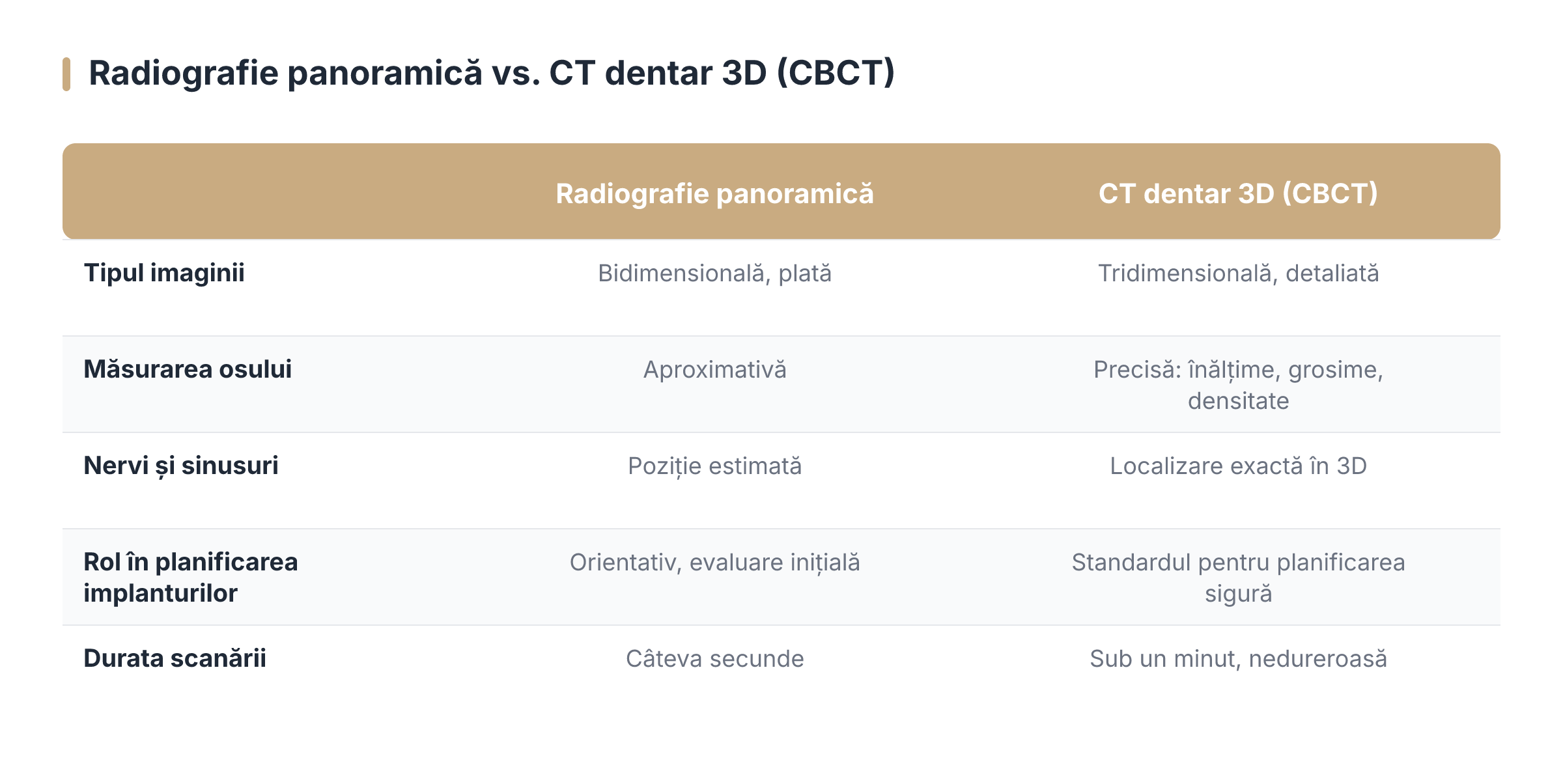
The centrepiece of the assessment, however, is the dental CT scan for implants, also known as CBCT (Cone Beam Computed Tomography). Unlike an ordinary panoramic X-ray, which gives a flat image, the dental CT reconstructs the jaw bones in three dimensions. The scan takes under a minute, does not hurt and uses far lower radiation doses than a conventional medical CT.
On the 3D images, the implant dentist measures with precision:
- The height and thickness of the bone available in each area where an implant would be inserted;
- Bone density, which influences the primary stability of the implants;
- The position of sensitive anatomical structures: the inferior alveolar nerve in the lower jaw and the maxillary sinuses in the upper jaw;
- Hidden lesions: cysts, periapical infections or bone resorption invisible on clinical examination.
For fixed sets of teeth of the All-on-4 or All-on-6 type, the CT is what tells us whether the implants can be positioned in the existing bone or whether additional procedures are needed, such as bone grafting or a sinus lift. You can read more about how we approach these cases on our dedicated page about dental implants in Cluj-Napoca.
Which blood tests will the dentist ask for before implants?
Blood tests are not usually done on the day of the consultation itself; the dentist recommends them after the assessment, depending on your age, medical history and the scale of the procedure. For a full-mouth rehabilitation on implants, which is a more extensive surgical procedure than a single implant, the preoperative assessment is more thorough.
Most commonly, the dentist asks for:
- A full blood count: it shows the general state of your blood and can flag anaemia or infections;
- Blood glucose and, if needed, glycated haemoglobin (HbA1c): essential for patients with diabetes or suspected diabetes, because uncontrolled diabetes slows down healing;
- A coagulation panel (INR, APTT): it checks how your blood clots, particularly important if you take anticoagulants;
- Liver and kidney function tests (transaminases, creatinine): for patients with known conditions or long-term treatments;
- Calcium, vitamin D and bone metabolism markers: sometimes recommended when there is osteoporosis or bisphosphonate treatment.
If the results raise questions, we work with your family doctor or with the specialist who treats you. The aim is not to turn you away from treatment, but to schedule the procedure under the safest possible conditions. The great majority of patients with well-controlled chronic conditions can receive dental implants without problems.
The implant treatment plan: what you receive at the end of the consultation
After the examination and the analysis of the CT scan, the dentist presents your implant treatment plan, personalised for your situation. In a multidisciplinary clinic like ours, when the case requires it, the implant dentist, the prosthodontist and, if needed, the surgeon or the periodontist all contribute to this plan, so that the solution is thought through from the implant to the final restoration.
A complete treatment plan for fixed teeth on implants includes:
- The diagnosis: the current condition of your teeth, gums and bone;
- The recommended solution: for example All-on-4, All-on-6 or individual implants, with a clear explanation of why it is suitable in your case;
- The stages and the timeline: any extractions, the placement of the implants, the healing period, the provisional restoration and the final restoration;
- The alternatives: what other options exist and how they compare;
- The cost estimate broken down by stage, so you know from the outset what to expect financially.
For patients with no remaining teeth, we discuss in detail how fixed teeth on implants work: how many implants support the restoration, whether you can receive fixed provisional teeth soon after the procedure and what the final result will look like. You have time to ask all your questions, and the plan stays with you, so you can review it at home, at your own pace. You do not have to make any decision on the spot.
How we discuss costs and financing
A full-mouth rehabilitation is a significant investment, and financial transparency is part of the consultation. The cost depends on the number of implants, whether bone grafting is needed, the type of prosthetic restoration and the materials chosen. You can consult the clinic's indicative prices at any time, and for extensive treatments there are instalment financing options, which you can discuss at your very first visit.
How to prepare for the first visit and what comes next
Preparing for the consultation is simple: come well rested, eat normally beforehand (there is no need to fast for the consultation or the CT scan) and bring the medical documents mentioned above. If you wear a removable denture, bring it with you, because the dentist can use it as a reference when planning your new restoration.
After the consultation, the typical steps are:
- you have the recommended blood tests done, if needed;
- you obtain any clearances from the specialist doctors who treat you;
- you choose the treatment option together with the dentist and set the timeline;
- you book the first stage, whether that is a professional cleaning, extractions or the placement of the implants itself.
In our experience with patients looking for fixed teeth in Cluj-Napoca, the biggest step is the first one: booking the consultation. Once you see the CT images, understand the plan and learn that there is a fixed, predictable solution for your situation, the uncertainty disappears and the decision becomes much easier. If you want to take this step, our team is here for you, and you can find the clinic's contact details on the website.
Frequently asked questions
How long does the first consultation for dental implants take?
Generally between 45 and 60 minutes, depending on the complexity of the case. In this time we discuss your medical history, examine your mouth, take the 3D dental CT scan and present the possible treatment directions. For full-mouth rehabilitations of the All-on-4 or All-on-6 type, we sometimes schedule a short second appointment to present the final plan, after all the data has been reviewed by the team.
Does anything hurt at the first consultation?
No. The first consultation involves no procedure: it is a conversation, a visual examination with simple instruments and a CT scan that takes under a minute and is completely painless. There are no injections, extractions or other procedures. Many patients who have put off visiting the dentist for years are surprised by how relaxed this first appointment is.
Is the dental CT scan compulsory before implants?
Yes, for safe implant planning the dental CT is considered the current standard. A panoramic X-ray gives only a two-dimensional image, while the CT shows the height, thickness and density of the bone in three dimensions, plus the exact position of the nerves and sinuses. Without this information, the implants would be positioned with a degree of approximation that we do not consider acceptable, especially in full-mouth rehabilitations.
Can I have the consultation if I have diabetes or other chronic conditions?
Yes, and we actually recommend that you do not postpone the consultation for this reason. Well-controlled chronic conditions, such as balanced diabetes or treated high blood pressure, do not rule out dental implants. At the consultation the dentist assesses your specific situation, asks for the relevant tests and, if needed, works with your specialist doctor to schedule the procedure safely. Most patients with chronic conditions can be treated successfully.
Will I find out the price of the treatment at the first consultation?
Yes, at the end of the consultation you receive a cost estimate broken down by stage, for the recommended treatment option and for the alternatives. The final cost depends on the number of implants, any additional procedures such as bone grafting and the type of prosthetic restoration chosen. You can also discuss instalment financing options at the same time, if you want to spread the investment.
Do I have to make a decision on the spot after the consultation?
No. The treatment plan stays with you and you have all the time you need to review it at home, discuss it with your family or ask further questions. We do recommend, however, not delaying the decision for too long if there are active infections or ongoing bone resorption, because the available bone can diminish over time, which can complicate later treatment.
This article is for information purposes only and does not replace a specialist consultation. For a diagnosis and a personalised treatment plan, please book a consultation.