

 Română
 Français
 Deutsch
 Español
 Italiano
What is 3D digital dental implant planning?
3D digital planning of dental implants is the process by which the doctor virtually establishes, on the computer, the exact position of each implant before the actual intervention. It is performed by superimposing a computed tomography (CBCT) with a 3D scan of the mouth, in specialized software that shows the bone, nerves, sinuses and the future prosthetic work. Based on this plan, a surgical guide can be manufactured, a 3D printed piece that directs the implants to the planned position, with a precision of less than a millimeter. In total rehabilitations of the all-on-4 or all-on-6 type, where 4 or 6 implants support an entire arch of fixed teeth, this planning makes the difference between a stable work in the long term and prosthetic compromises that are difficult to correct later.
In other words, the surgical intervention is done twice: once virtually, without any risk, and then in reality, following an already verified plan. In our clinic in Cluj-Napoca, we use this digital flow precisely because the patients who come to us for teeth fixed on implants They usually have complex cases: resorbed bone, long-missing teeth, old work that has failed.
Digital planning steps: from scan to surgical guide
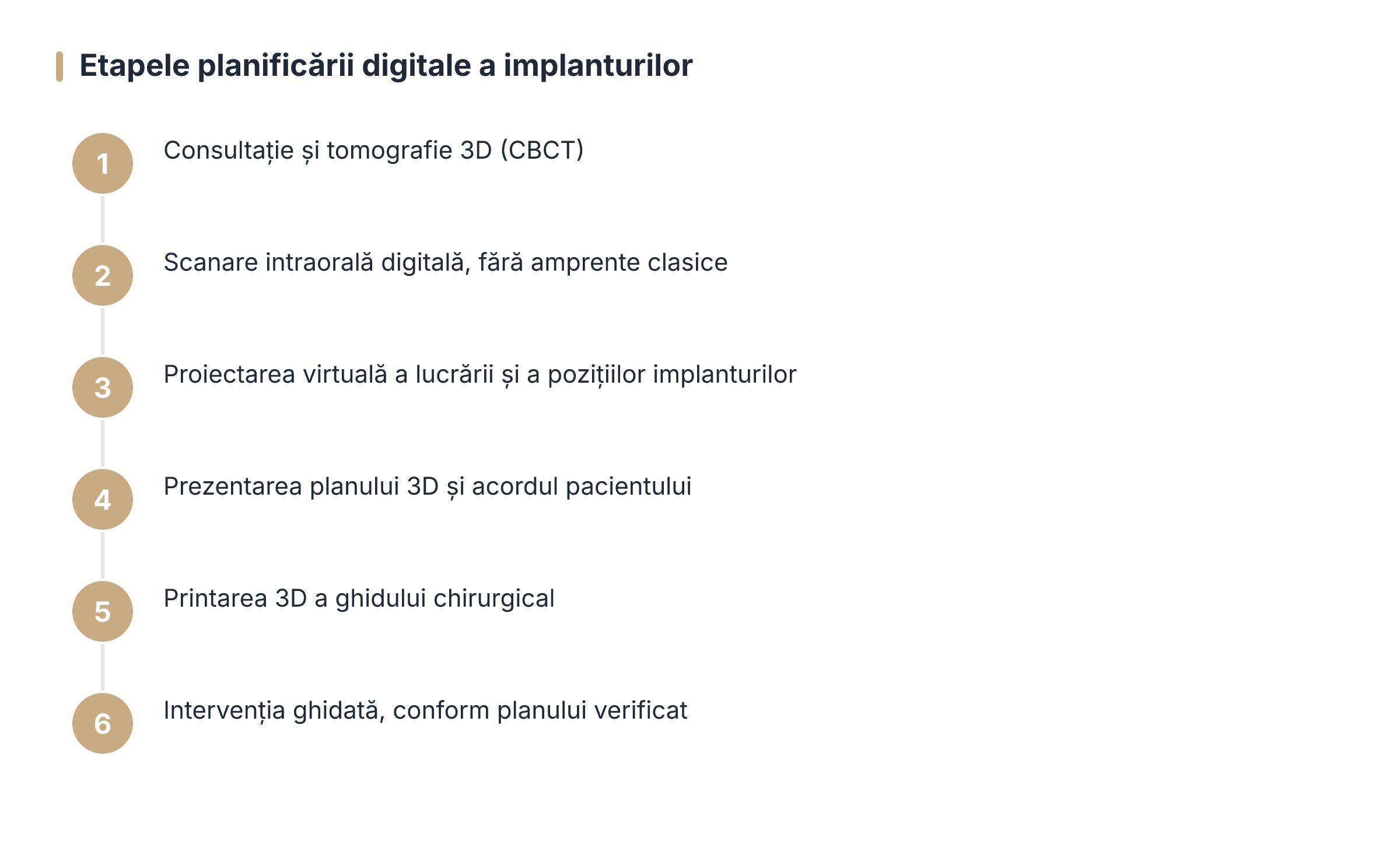
The digital flow follows a logical sequence of stages, each with its own role.
1. CBCT computed tomography
It all starts with a dental cone beam tomography (CBCT), a 3D X-ray that shows the jawbone in all three dimensions: height, width and density. Unlike a classic panoramic X-ray, CBCT allows us to measure exactly how many millimeters of bone there is in each area and where sensitive anatomical structures pass, such as the inferior alveolar nerve in the mandible or the maxillary sinuses above.
For the patient, the investigation lasts a few tens of seconds and is painless. For the doctor, it is the map on which the entire plan is built.
2. Intraoral 3D scanning, without classic impressions
Next, a 3D scan of the mouth is performed with an intraoral scanner, a small camera that digitally photographs the remaining teeth and gums. The result is an accurate virtual model of the oral cavity, obtained in a few minutes, without the spoons of impression paste that make many patients feel sick. In completely edentulous patients, the scan captures the shape of the gingival ridge and the relationship between the jaws.
This 3D scan for dental implant it is then superimposed over the tomography in the software, so that the doctor simultaneously sees the deep bone and the gum surface.
3. Virtual implant design starting from the final smile
This is where the essential and less visible part for the patient happens. The software first designs the future prosthetic work, i.e. the final teeth, and only then does the implant placement take place to optimally support it. This is the principle of prosthetically guided planning: we do not place implants where it is convenient, but where the future dentition requires them.
For each implant, the length, diameter, angulation and depth are virtually chosen, checking the distance from nerves, sinuses and the roots of neighboring teeth. In cases of all-on-4, For example, posterior implants tilt in a controlled manner to bypass areas with insufficient bone, and this angle must be calculated precisely.
4. Printing the surgical guide
The approved plan becomes a surgical guide: a piece of biocompatible material, manufactured by 3D printing, that is fixed on the teeth or gums during the intervention. The guide has metal channels that direct the drills and implants exactly to the planned position, angulation and depth. Basically, the intervention becomes a faithful transposition of the digital plan, not a decision made on the spot.
Computer-guided dental implant versus classic technique: what does the patient gain?
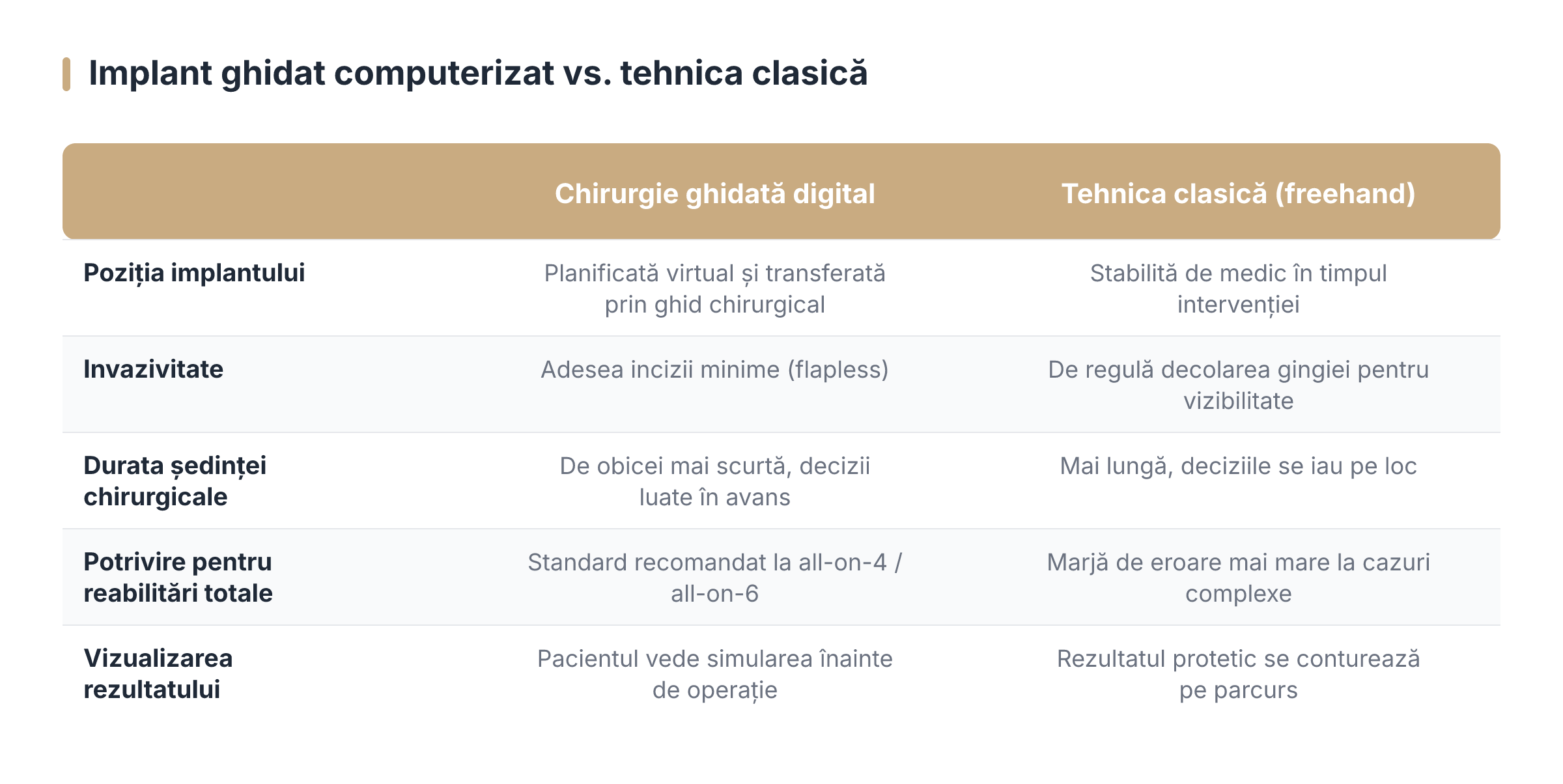
A computer-guided dental implant is not a technological fad, but a change in approach with concrete benefits for the patient. In our clinical experience, the differences are felt both during the intervention and in the final prosthetic result.
- Accuracy and predictability: the implant reaches the planned position, previously verified on tomography, which reduces the risk of touching sensitive anatomical structures.
- Often less invasive intervention: In many cases, the guide allows for the flapless technique, i.e. implant insertion through a minimal incision, without extensive gum lift, with reduced discomfort and swelling after the intervention.
- Shorter operating time: Important decisions were made during the planning stage, so the surgical session runs more smoothly, a real advantage when inserting 4-6 implants on the same day.
- Superior prosthetic result: Because the implants are positioned according to the future work, the final fixed denture has balanced support, easier hygiene, and better aesthetics.
- Clear communication: The patient sees the plan on the screen before deciding, understands how many implants he is receiving, where and why.
The classic technique, in experienced hands, remains a valid option for simple cases, with a single implant and abundant bone. However, in complex rehabilitations, the acceptable margin of error is much smaller, and the digital workflow becomes the standard we recommend.
Why does digital planning matter especially for all-on-4 and all-on-6?
In a total rehabilitation, the entire arch of fixed teeth is supported by only 4 or 6 implants. Each implant becomes a pillar of resistance, and its position directly influences the biomechanics of the entire work. A deviation of a few millimeters in an isolated implant can be compensated prosthetically; the same deviation in a pillar in an all-on-4 construction can mean a work that is tense, difficult to sanitize or with an uneven distribution of masticatory forces.
In addition, completely edentulous patients frequently have resorbed bone, because bone recedes over time where teeth are missing. Digital planning allows us to maximize existing bone, strategically tilting implants to avoid sinuses and nerves, and often avoiding or reducing bone grafting. And when bone addition is still necessary, we know it from the planning phase, we do not discover it during the intervention.
Another major advantage in these cases is the predictability of the temporary work. Because the position of the implants is known in advance, the laboratory can prepare the fixed temporary denture in advance so that the patient is not left without teeth during the healing period. dental implants made in our clinic in Cluj, this coordination between surgery and prosthetics is done on the same digital plane, from the first consultation to the final work.
What role do the implant system and the multidisciplinary team play in the digital flow?
A digital workflow only really works when all components speak the same language: planning software, surgical guide, implants and prosthetic components. That’s why it’s important to work with proven implant systems, with complete documentation and dedicated digital components. An example from our practice are Straumann dental implants, natively integrated into guided surgery workflows, from planning to the final prosthetic abutment.
Equally important is the human factor. The digital planning of a total rehabilitation is not the job of a single doctor: the implantologist establishes the surgical strategy, the prosthodontist defines the future dentition, and technology brings them together at the same table, in front of the same 3D plan. As multidisciplinary clinic, we built this way of working precisely for complex cases, where the correct decision requires multiple specialized perspectives.
It is also worth mentioning what the technology does not do: it does not replace clinical judgment. The software proposes, the doctor disposes. Interpreting the tomography, assessing the quality of the bone, choosing the right moment to load the implants remain medical decisions, made by people with experience in implantology.
How does the process work for the patient and how long does it take?
For the patient, their part of the digital workflow is surprisingly simple. At the first consultation, we do the clinical examination, CBCT tomography and intraoral scan, all in the same visit. The next few days the team works on the digital plan: we analyze the bone, simulate the implant positions and design the future work.
At the second meeting, we present the plan: the patient sees on the screen their own anatomy, the proposed implant positions and a simulation of the prosthetic result. It is time for questions, discussion of options, stages and costs. Only after the patient agrees do we order the surgical guide and schedule the intervention.
The factors that influence the total duration and cost are the number of implants, the need for extractions or bone addition, the type of provisional work and the complexity of the case, which is why any serious estimate starts with a consultation and a tomography, not with a generic price displayed. Patients outside Cluj, including those from the diaspora who organize their treatment in compact periods, can find out how we coordinate the stages on the dedicated page dental tourism in Cluj-Napoca. If you are missing many teeth or are wearing a removable prosthesis that no longer satisfies you, an implantology consultation with digital planning is the first concrete step, and the one that finally gives you a clear picture of the real solutions for your case.
Frequently asked questions
Is the CBCT scan necessary for planning painful or irradiating?
CBCT tomography is completely painless: you stand or sit, and the device rotates around your head for a few tens of seconds. The radiation dose is significantly lower than in a classic medical CT tomography, being an investigation dedicated to the dental area. The diagnostic benefit is major, because without the 3D image of the bone, the position of the implants cannot be safely planned, especially in total rehabilitations.
Does intraoral scanning completely replace the classic paste impression?
In the digital flow, yes, in most situations. The intraoral scanner creates a virtual model of the teeth and gums in a few minutes, without the spoons of impression material that often cause gag reflex. The digital model is precise and is transmitted instantly to the laboratory, which also eliminates the possible deformations of classic impressions during transport. There are particular clinical situations in which the doctor can combine the methods, but for the patient the experience is noticeably more comfortable.
Does surgical guide-guided surgery hurt less than classic surgery?
The procedure is done under local anesthesia anyway, so you shouldn't feel any pain during it, regardless of the technique. The difference is especially noticeable afterwards: guided surgery often allows for minimal incisions, without extensive gum lift, which usually means less swelling and less postoperative discomfort. However, each case is different, and your doctor will explain to you during your consultation what to expect in your specific situation.
Can I see what my teeth will look like before the surgery?
Yes, this is one of the important advantages of digital planning. Because the plan starts from the design of the future prosthetic work, we can show you on the screen the simulation of the final dentition, the positions of the implants and their relationship to your bone. This way, the decision to start treatment is made with full knowledge of the facts, and the expectations related to the appearance and functionality of the fixed teeth are aligned with the medical plan from the beginning.
Does digital planning shorten the overall duration of implant treatment?
The surgical phase usually proceeds faster and more smoothly, because important decisions have been made in advance, and the provisional work can be prepared in advance by the laboratory. However, the total duration of the treatment also depends on biology: the bone needs its own healing and implant integration period, which cannot be rushed by any technology. Digital planning optimizes organization and precision, and the doctor sets the right pace for each patient.
I have a small bone. Is digital planning still useful in my case?
It is in these cases that digital planning brings a real benefit. 3D tomography shows exactly where there is usable bone, and the software allows for strategic positioning of implants, including their controlled tilt, to capitalize on the available bone. This way, bone grafts can sometimes be avoided or reduced, and when addition remains necessary, you know it from the beginning, with clear stages and costs. The correct conclusion for your case is only established during a consultation with CBCT investigation.
This article is for informational purposes only and is not a substitute for a professional consultation. For a personalized diagnosis and treatment plan, schedule a consultation.