

 Română
 Français
 Deutsch
 Español
 Italiano
What is a temporary fixed prosthesis on implants?
The temporary fixed prosthesis on implants is a complete dental work, screwed onto the newly inserted implants, which the patient usually receives 24-72 hours after the intervention. It offers you fixed, functional and aesthetic teeth from the first day, but it is not the final work: its role is to protect the implants during the healing period, which lasts an average of 4-6 months, and to help remodel the gums. Only after the implants have fully integrated into the bone is the definitive work performed, made of a much more resistant material, tailored to the stabilized situation of the gums and bite.
When you hear about fixed teeth in 24 hours or fixed dentures in one day, this is exactly what this temporary work is about. It is a real promise and a huge step forward from the past, when patients were left without teeth or with uncomfortable removable dentures for months. However, it must be understood correctly: the 24 hours refer to the immediate temporary work, not the final work.
In our clinic in Cluj-Napoca we use this protocol especially for total rehabilitations of the type fixed dentures on implants, i.e. All-on-4 and All-on-6, where the patient, even if completely edentulous (without teeth), goes home with fixed teeth shortly after the operation.
Why isn't the final paper due on the first day?
The explanation is biology, not clinic organization. A dental implant requires a period of osseointegration, the process by which bone grows around the implant and permanently fixes it. This process takes an average of 4-6 months and cannot be significantly accelerated, regardless of the technology used.
If we installed a rigid and heavy final work from day one, we would risk several problems:
- Overloading of implants: In the first months, the implants are not yet biologically fixed in the bone. Excessive masticatory forces, transmitted through a rigid work, can compromise integration.
- Gum change: After extractions and implant placement, the gums and bone remodel. The gum contour on the day of surgery looks different after 4-6 months. A final restoration done on the first day would not fit perfectly later.
- Bite not yet stabilized: In patients who have been without teeth for a long time or with removable dentures, the correct bite position is gradually adjusted. The temporary denture functions as a test in real conditions.
In our clinical experience, patients who understand this staging from the beginning are much more relaxed during treatment. It is not a postponement, but a protection of the investment you have made in dental implants.
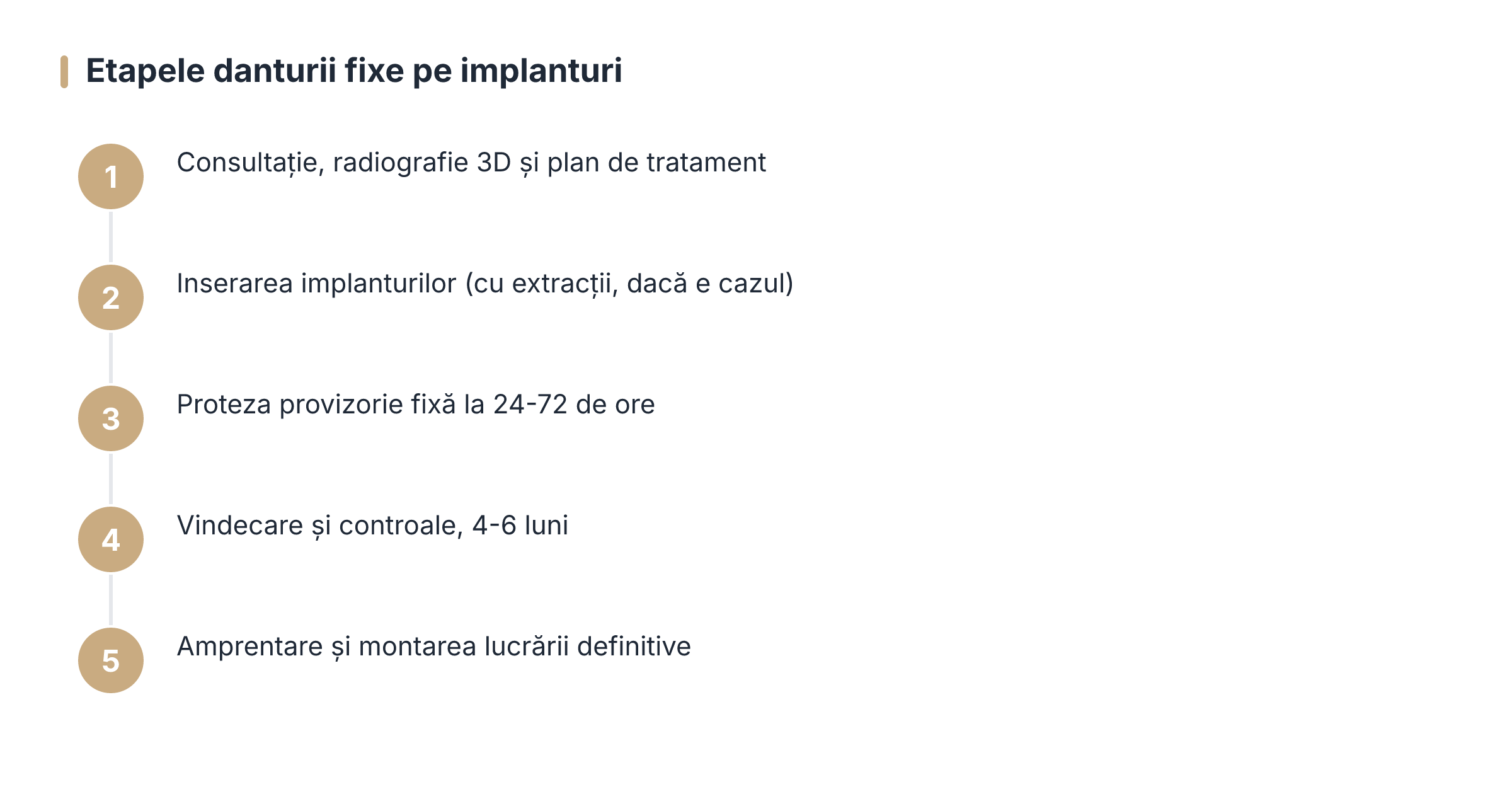
What are the stages of a fixed denture on implants?
In a total All-on-4 or All-on-6 rehabilitation, the typical course looks like this:
- Consultation and planning: clinical examination, 3D radiography (CT), analyses and personalized treatment plan. In our multidisciplinary clinic, complex cases are evaluated together by the implantologist and the prosthodontist.
- Insertion of implants: surgical intervention, often combined with the extraction of compromised teeth, cleaning of infections where appropriate, in the same session.
- Impression and fitting of the fixed provisional prosthesis: After 24-72 hours, you receive the temporary restoration screwed onto the implants. You go home with fixed teeth.
- Healing and adaptation period: 4-6 months of wearing the temporary prosthesis, with periodic check-ups and an adapted diet in the first weeks.
- The final work: After confirming the integration of the implants, a new impression is taken and the final work is performed, adjusted aesthetically and functionally.
We have detailed how the first visit goes, what tests are needed and what questions to prepare in a separate article about the initial consultation for permanent teeth. Important to remember: the total duration of treatment is usually 4-7 months, even if you have had your permanent teeth from the first days.
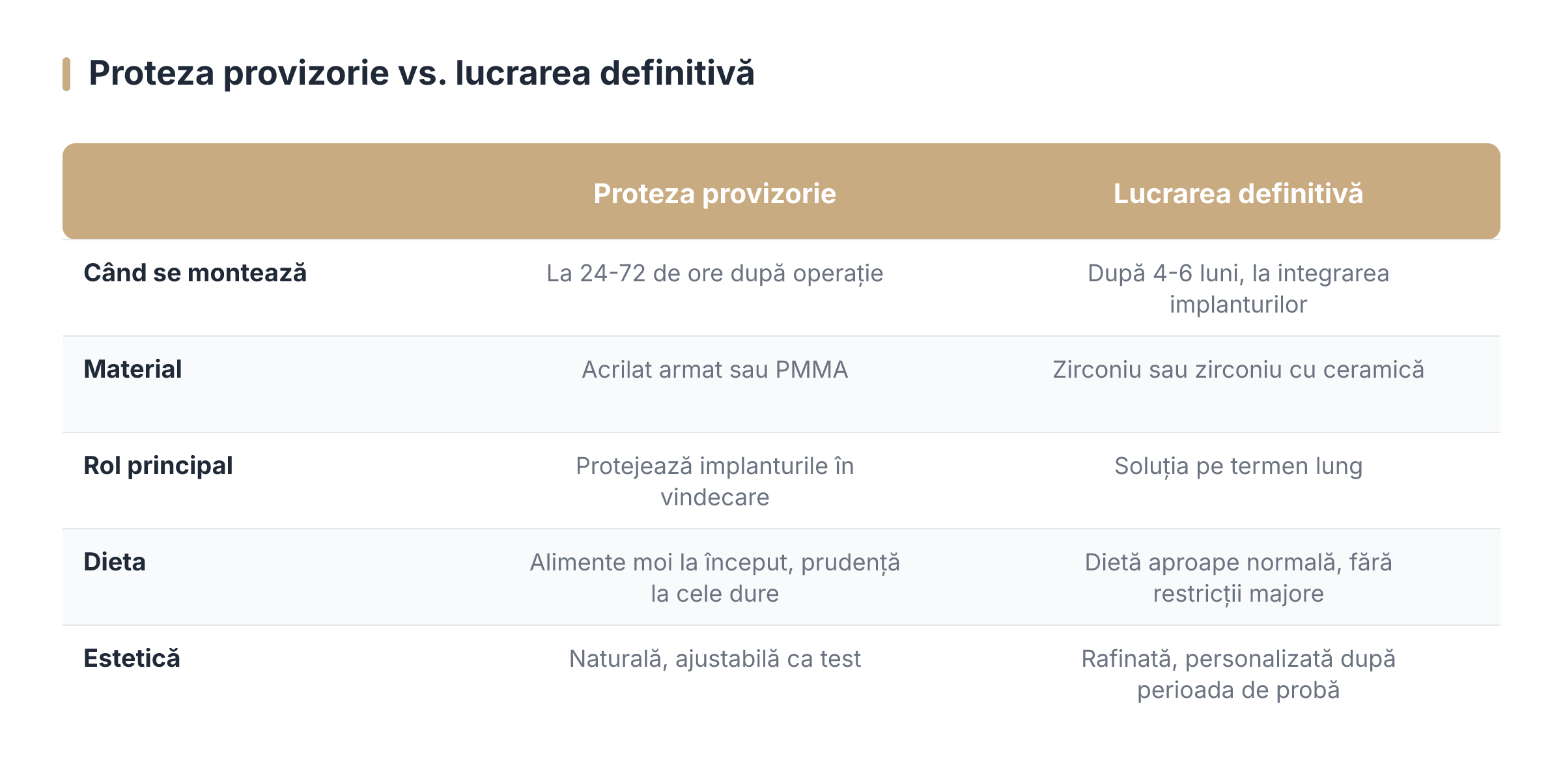
Temporary prosthesis versus permanent restoration: what are the differences?
The two works have different roles and are constructed differently.
Temporary prosthesis It is usually made of reinforced acrylic or milled PMMA, lighter materials that absorb chewing forces and protect the healing implants. It is aesthetic and functional, but designed for use for several months: it can wear out, it can discolor slightly over time and requires a more cautious diet at first, avoiding very hard foods.
The definitive work is made of high-strength materials, most commonly monolithic zirconia or ceramic-clad zirconia. It is designed based on everything we learned from the provisional period: how the gum is positioned, how the bite works, what aesthetic adjustments the patient wants. You can read more about the materials of the definitive works, such as zirconia or E-Max ceramic, on our page about dental crowns.
A less-discussed advantage of the temporary stage: it acts as a dress rehearsal. If you want your teeth to be a little longer, whiter, or a different shape, these changes are tested on the temporary and transferred to the final work. The final result is not a surprise, but a refined version of something you've already been wearing for months.
How do you live with the temporary prosthesis during the healing period?
Most of our patients adapt surprisingly quickly to temporary dentures, especially those who have previously worn removable dentures. The work is fixed, does not move when talking or eating, and looks natural.
Some practical recommendations for this period:
- Diet: During the first 6-8 weeks, we recommend soft foods, cut into small pieces. Gradually, the diet is diversified, but very hard foods (shells, seeds, whole nuts) should be avoided while you are wearing the temporary denture.
- Hygiene: careful brushing, rinsing the mouth and cleaning the area between the restoration and the gum, according to the instructions received at the clinic.
- Controls: Scheduled visits allow us to check healing, adjust the bite, and correct any discomfort early.
- Signs to contact a doctor: A loose joint, a crack, or persistent discomfort cannot be fixed at home. A quick adjustment can prevent bigger problems.
It is normal for speech to be slightly different in the first few days and for the gums to be sensitive after the procedure. These sensations usually improve within one to two weeks.
What influences the cost and how do you plan the treatment?
Patients searching online fixed dentures in 24 hours price often find offers that are difficult to compare. The reason: some prices displayed only include implants and temporary dentures, not the permanent work. Therefore, the first correct question at any consultation is: What exactly does the price include, up to the final work?
The main factors that influence the cost of a total rehabilitation are:
- the number of implants (4 or 6 per arch) and their brand;
- the need for additional procedures, such as extractions or bone addition;
- the material of the final work (acrylate on metal support, monolithic zirconia, zirconia with ceramic);
- treatment of a single arch or both.
Because a total rehabilitation is an important investment, we also offer our patients options for: financing of dental treatments, with payment in installments over the course of the stages. A clear treatment plan, received in writing after the consultation, is the best planning tool: you will know exactly what happens at each stage and how much each step costs. If you are considering fixed dentures on implants, we encourage you to start with a specialist consultation, in which we assess your specific situation and explain the complete process, from provisional to final work.
Frequently asked questions
Will I be left without teeth between the surgery and the final work?
No. This is precisely the role of the fixed provisional prosthesis: 24-72 hours after the insertion of the implants, you receive a complete restoration, screwed onto the implants, with which you eat, speak and smile normally. You wear it throughout the healing period, usually 4-6 months, until the definitive restoration is made. In rare cases, when the implants do not have sufficient stability on the day of the operation, the doctor may temporarily recommend another provisional solution, but this is discussed transparently during the consultation.
How long do I wear the temporary prosthesis on implants?
It usually takes between 4 and 6 months for the implants to integrate into the bone. The exact duration depends on the quality of the bone, any additional procedures (such as bone grafting) and the healing rate of each patient. The doctor confirms through a clinical and radiological check that the implants have integrated, and only then does the impression for the definitive work proceed. We do not recommend shortening this period, because it protects the result in the long term.
Can I eat normally with the temporary work?
Yes, with a few precautions at first. In the first 6-8 weeks we recommend soft foods cut into small pieces, so as not to overload the healing implants. Gradually return to an almost normal diet, but very hard foods, such as shells, seeds or whole nuts, should be avoided while you are wearing the temporary. The temporary work is made of lighter materials than the permanent one, precisely to absorb the forces, so it is worth treating it with a little care.
Does the temporary prosthesis look different from the final work?
The temporary prosthesis is designed to look natural and aesthetic, and many patients are pleasantly surprised from the first day. The definitive work, made of zirconium or zirconium with ceramic, however, has a superior translucency and appearance, plus much greater resistance. A great advantage is that the temporary works as a test: the shape, length and shade of the teeth can be adjusted on it, and your preferences are then transferred to the final work.
What happens if the temporary denture cracks or moves?
Contact the clinic for a quick adjustment, do not wait for your scheduled check-up. Small cracks can often be repaired the same day, and a loose screw can be tightened in a short visit. It is important not to continue chewing on a removable restoration, as uncontrolled forces can damage the healing implants. Such situations are manageable if treated early and do not compromise the final result of the treatment.
This article is for informational purposes only and is not a substitute for a professional consultation. For a personalized diagnosis and treatment plan, schedule a consultation.