

 Română
 Français
 Deutsch
 Español
 Italiano
What is the fast and fixed procedure and how does it work in brief?
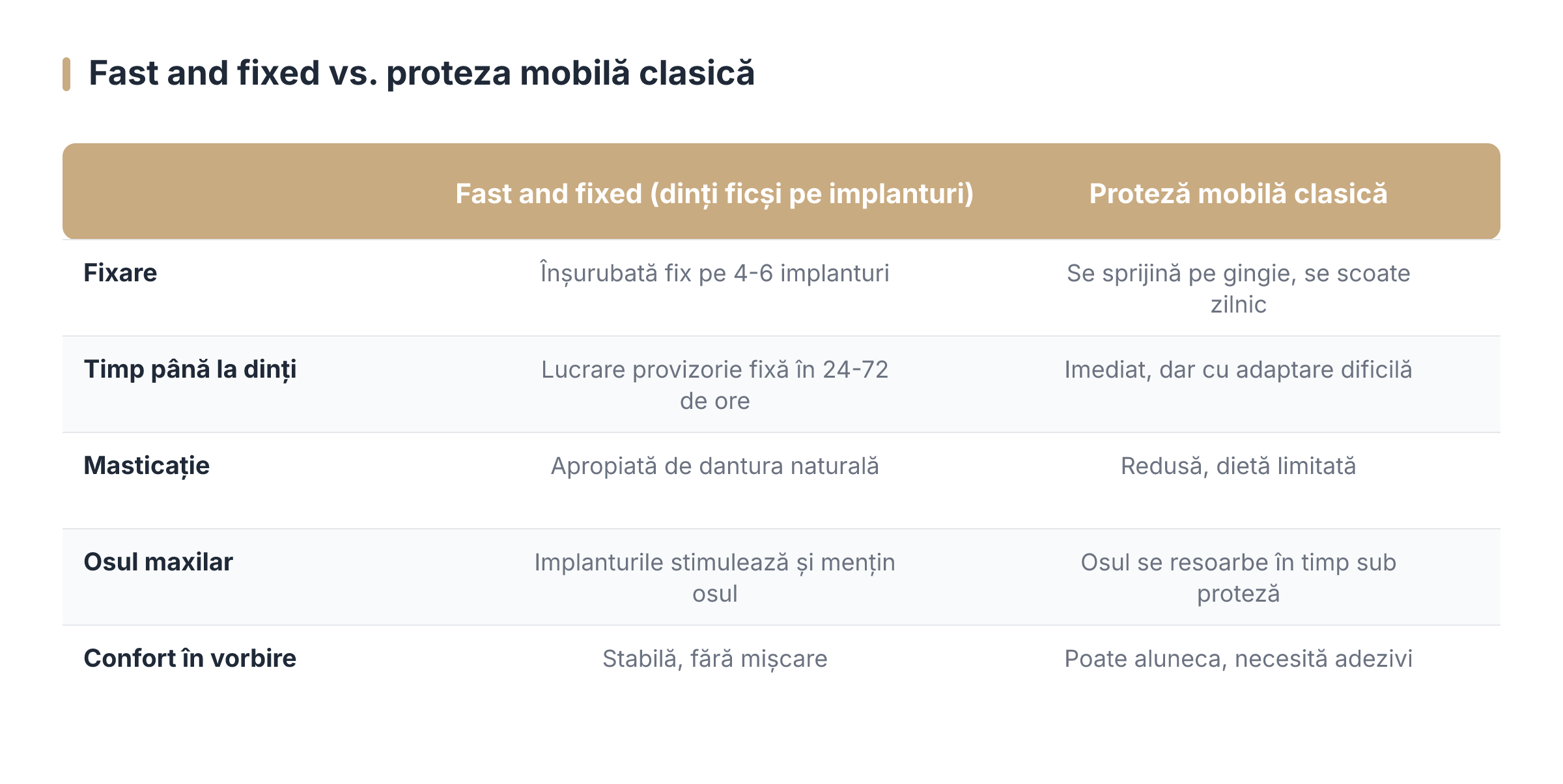
Fast and fixed is the commercial name of a surgical procedure through which an edentulous patient (with no teeth or with compromised teeth) receives, in a single session, 4 to 6 dental implants per arch and, within 24-72 hours, a fixed temporary restoration screwed onto those implants. In practice, the extraction of unsalvageable teeth, the placement of the implants and the fitting of the temporary teeth are concentrated into a very short interval, and the patient goes home without the long period of wearing a removable denture. When it is properly planned, digitally, based on a dental CT scan, and carried out by an experienced surgical team, it is a predictable and safe procedure for most edentulous patients.
At our clinic in Cluj-Napoca, this type of treatment corresponds to the all-on-4 and all-on-6 concepts, meaning fixed teeth on implants for the entire arch. Many patients come to us searching for exactly the term "fast& fixed", so in this article we explain what it involves surgically and, above all, where the safety of the procedure comes from.
An important detail from the start: "fast" refers to the fact that you get fixed teeth quickly, not to the procedure being done in a hurry. The fast part is what the patient sees; the slow, meticulous part, the planning, happens beforehand, behind the screens.
Who is the right candidate for fast and fixed?
The typical profile of the patient we treat with this method is an adult who is fully edentulous or has periodontally compromised, mobile, unsalvageable teeth, who wears a removable denture or is about to lose their last teeth. Age in itself is not an exclusion criterion; general health matters far more than the year of birth.
At the consultation we assess a few concrete eligibility criteria:
- Bone volume and quality, measured on the 3D dental CT scan. The advantage of the tilted implant concept is that it makes use of the existing bone in the anterior regions, where it is best preserved, often avoiding bone grafting or a sinus lift.
- General health: controlled diabetes, treated hypertension or anticoagulant therapy do not rule out the procedure, but they require additional preparation and, at times, cooperation with your treating physician.
- Smoking: it is not an absolute contraindication, but it increases the risk of healing complications, and smokers receive clear recommendations from us for the perioperative period.
- The primary stability of the implants: this criterion can only be checked during the surgery itself and it determines whether the fixed restoration can be fitted immediately; we detail it below.
There are also situations in which we recommend a different route: insufficient bone even for tilted implants, untreated acute infections, uncontrolled systemic disease or severe untreated bruxism. In these cases, a staged plan with prior preparation is safer than forcing immediate loading.
How does the day of the surgery unfold, step by step?
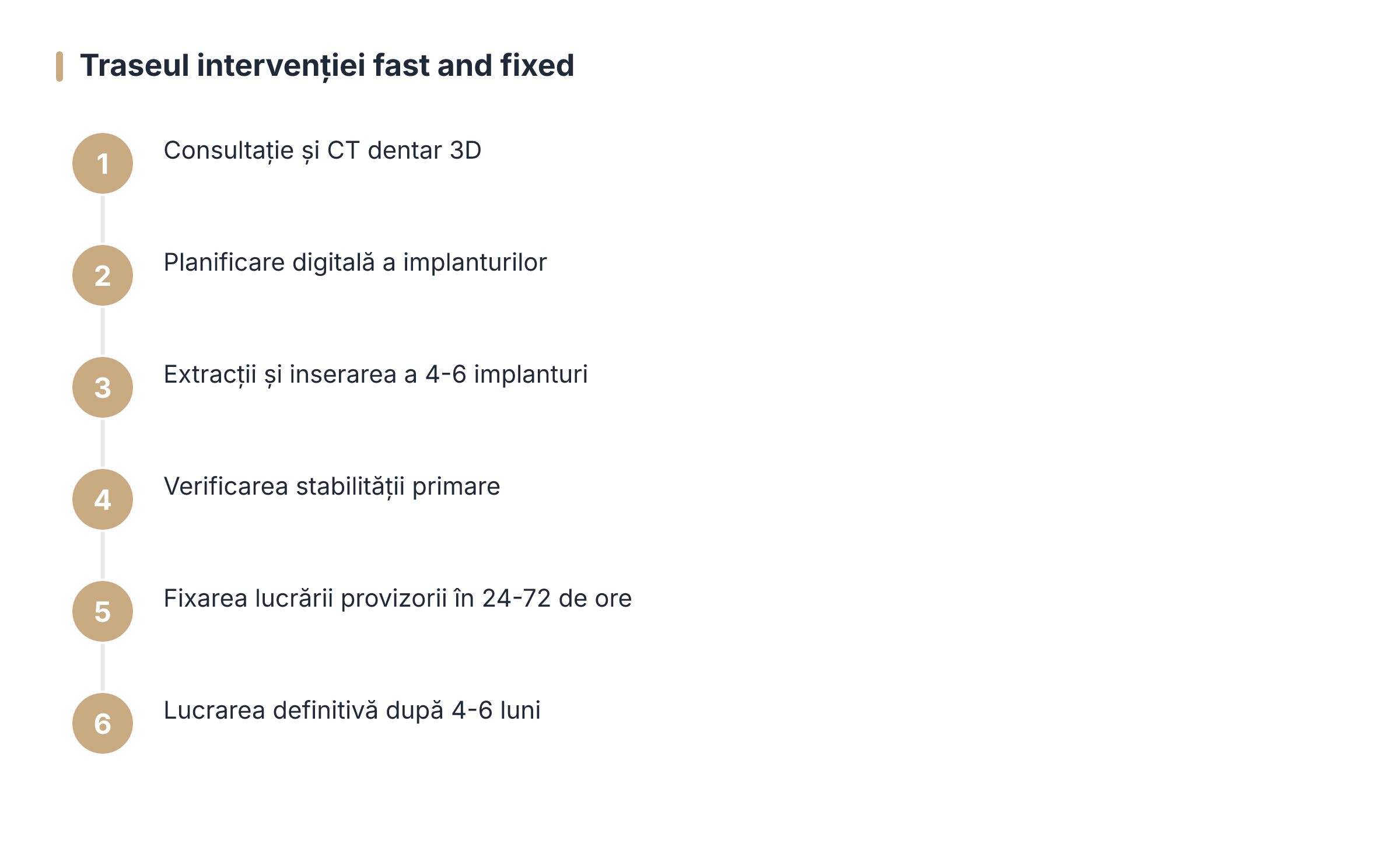
For our patients, the day of the surgery is in fact the end point of a journey that begins a few weeks earlier. Here is what the whole path looks like.
Before the surgery: digital planning
Everything starts with a 3D dental CT scan (cone beam computed tomography), on the basis of which we determine in the software the position, length and angulation of each implant, avoiding the sensitive anatomical structures: the inferior alveolar nerve in the mandible and the maxillary sinuses in the upper jaw. This digitally guided surgery means that, on the day of the procedure, the team carries out a plan that has already been verified, rather than improvising according to what it finds. The temporary restoration is also prepared at this stage, together with the dental technician.
Step 1: anaesthesia and extractions
The procedure is performed under local anaesthesia and, for anxious patients, we can add conscious sedation. The unsalvageable teeth are extracted in the same session, and the sockets are carefully cleaned of infected tissue. The fact that extractions and implants are done on the same day is not a compromise but an advantage: the patient goes through a single healing process instead of two.
Step 2: placing the implants
Four to six implants are placed per arch, according to the digital plan. The posterior implants are usually tilted, precisely in order to use the available bone and avoid risk areas. At each implant we measure the primary stability, that is, the force with which the implant is mechanically anchored in the bone from the very first moment. This is the key condition for immediate loading: only if the values are sufficient do we fit the fixed restoration straight away. If in a given patient the stability does not reach the safety threshold, we say so openly and adapt the plan, because an implant loaded prematurely risks failing to integrate.
Step 3: the impression and fitting the temporary teeth
Special abutments for immediate loading are mounted on the implants, the impression is taken, and within 24-72 hours the fixed, screw-retained temporary restoration is ready and is fitted onto the implants. The patient goes home with fixed teeth, with clear recommendations for a soft diet and hygiene during the integration period. The final restoration is made once the implants have fully integrated into the bone, usually after 4-6 months.
How safe is the procedure and where does that safety come from?
The question we hear most often at consultations is "but is it safe to place implants and teeth on the same day?". The honest answer: yes, provided that every link in the safety chain is respected. Safety does not come from a single element, but from the sum of them.
- Planning on a 3D CT scan eliminates most of the anatomical risks. We know in advance, to a fraction of a millimetre, where the nerve is, where the sinus is and how much bone we have available.
- The implant system matters for predictability. At our clinic we work with Straumann implants, a Swiss system with long-standing clinical documentation, including for immediate loading protocols.
- The primary stability criterion is the intraoperative safeguard: immediate loading is carried out only when the implants allow it, not as an absolute rule.
- The multidisciplinary team: with us, the surgeon, the prosthodontist and the dental technician work together on the same case, from planning through to the final restoration. The patient is not "passed around" between practices that do not communicate.
- Splinting the implants through the fixed restoration distributes chewing forces evenly, which protects each implant during the integration period.
As with any surgical procedure, there are risks: bleeding, swelling, discomfort in the first few days and, rarely, the failure of an implant to integrate. The difference is made by the way these risks are anticipated and managed. That is why we insist that the assessment be done thoroughly, not in a rush, even if the name of the procedure contains the word "fast". You can find out more about our approach to implantology on the page dedicated to dental implants in Cluj.
What does the patient feel during the procedure and in the days afterwards?
During the procedure, under local anaesthesia, the patient feels pressure and vibrations, not pain. The surgery for one arch usually takes from one to a few hours, depending on the number of extractions and the complexity of the case. Patients with dental anxiety can opt for sedation, in which case the memory of the procedure remains vague.
In the first 2-3 days after surgery, swelling, a diffuse tenderness and slight bleeding are normal, and are controlled with the prescribed medication and cold compresses. Most of our patients resume their usual activities within a few days. The important rules for the first weeks:
- a soft diet, with no hard or sticky foods, so as not to overload the integrating implants;
- careful hygiene according to the instructions, including rinses with the recommended solutions;
- avoiding smoking, intense physical effort and the sauna during the period indicated by the dentist;
- attending the scheduled check-ups, where we monitor healing and the fit of the temporary restoration.
One aspect we always emphasise: the temporary restoration is not a luxury, but part of the safety protocol. It protects the implants during the integration period and allows us to fine-tune the aesthetics and the bite before the final restoration.
What should you ask at the consultation and how do you prepare for the decision?
If you are considering a full fixed rehabilitation, the assessment consultation is the moment when you get answers that apply to your case, not to a general one. We recommend coming prepared with specific questions:
- Do I have enough bone for tilted implants, or are additional procedures needed?
- How many implants do you recommend in my case, 4 or 6, and why?
- What happens if, during the surgery, implant stability does not allow immediate loading?
- What does the complete timeline look like, from surgery to the final restoration?
- What adjustments to my current medication are needed before the procedure?
The cost of a fast and fixed rehabilitation depends on the number of implants, on whether extractions and any preparatory procedures are necessary, and on the material of the temporary and the final restoration. That is precisely why a serious estimate can only be given after the CT scan and the clinical examination, and at our clinic the treatment plan details every stage, with the corresponding costs, before you make a decision.
For edentulous patients, the step from a removable denture to fixed teeth is often closer than it seems. An assessment with a 3D CT scan tells you exactly where you stand and what options you have, and the details about the fixed teeth on implants solution can be found on our dedicated page.
Frequently asked questions
Is fast and fixed the same thing as all-on-4 or all-on-6?
Essentially, yes. Fast and fixed is a commercial name for the concept of full fixed rehabilitation with immediate loading: 4 to 6 implants per arch, of which the posterior ones are tilted, plus a fixed temporary restoration fitted within 24-72 hours. All-on-4 and all-on-6 describe the same principle, the difference being the number of implants. At the consultation, the choice between 4 and 6 implants is made according to bone volume, the arch being treated and the patient's chewing forces.
Can the extractions and the implants be done on the same day?
Yes, and this is in fact one of the advantages of the protocol. The unsalvageable teeth are extracted, the sockets are cleaned of infected tissue, and the implants are placed in the same session, in the positions established during digital planning. For the patient this means a single procedure and a single healing period, instead of two separate surgeries months apart. The condition is that acute infections are controlled and that the implants achieve sufficient primary stability in the remaining bone.
What happens if the implants cannot be loaded immediately?
During the surgery we measure the primary stability of each implant, that is, the force with which it is mechanically anchored in the bone. If the values do not reach the safety threshold, we do not fit the fixed restoration straight away, because an implant loaded prematurely risks failing to integrate. In that case, the implants are left to heal covered for a few months, and the patient receives an adapted temporary solution. This is a rarer scenario when planning is done correctly, but it is part of the safety protocol and we discuss it openly before the surgery.
How long until I get my fixed teeth after the surgery?
The fixed temporary restoration, screwed onto the implants, is usually fitted within 24-72 hours of the procedure, following the impression taken on the day of surgery. With it you can eat, speak and smile normally, with the precaution of a soft diet in the first weeks. The final restoration is made after the implants have fully integrated into the bone, usually at 4-6 months, when the tissues have stabilised and we can finalise the aesthetics and the bite to the desired level.
I am a smoker and I have diabetes. Can I still have fast and fixed?
In many cases, yes, but with additional preparation. Controlled diabetes, confirmed by recent blood tests, does not rule out the procedure; where necessary, we cooperate with your treating physician to adjust your treatment around the time of the surgery. Smoking increases the risk of healing complications, so we recommend reducing or stopping it at least during the perioperative period. The final decision is taken after a complete assessment: 3D CT scan, blood tests and a discussion about your medical history. We decline the procedure only when the risks outweigh the benefits, and in that case we propose staged alternatives.
Is the fast and fixed procedure painful?
The procedure is carried out under local anaesthesia, so during it you feel pressure and vibrations, not pain. For patients with dental anxiety we can add conscious sedation, which brings about a state of deep relaxation. After the surgery, in the first 2-3 days, swelling and tenderness are normal and are well controlled with the recommended medication. Most of our patients describe the postoperative period as easier than they expected, especially compared with the chronic discomfort of compromised teeth or of a removable denture.
This article is for information purposes only and does not replace a specialist consultation. For a diagnosis and a personalised treatment plan, please book a consultation.