

 Română
 Français
 Deutsch
 Español
 Italiano
What bleeding gums around an implant mean
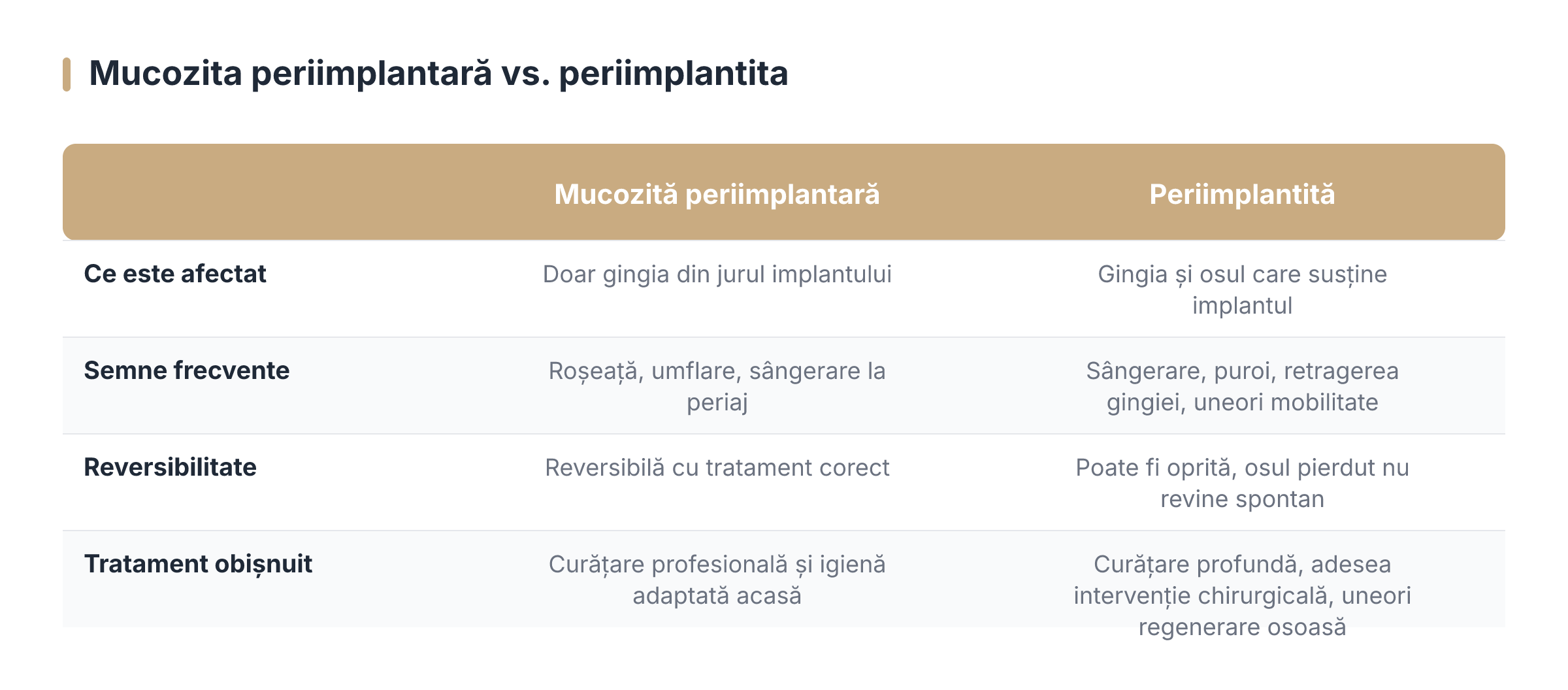
Gum bleeding around implants is not normal and almost always indicates inflammation caused by bacterial plaque. In the early stage we speak of peri-implant mucositis, an inflammation limited to the gum, which is reversible if treated. If the inflammation persists and goes on to destroy the bone supporting the implant, it becomes peri-implantitis, a condition that can be halted, but whose bone loss does not regenerate on its own. That is why the first episode of bleeding deserves to be assessed at a check-up, not ignored.
A dental implant is a titanium screw integrated into the bone, onto which the crown or fixed bridge is attached. Unlike a natural tooth, there is no periodontal ligament around an implant, the elastic structure that connects the tooth to the bone and protects it against bacteria. The gum attaches to the implant less firmly, so inflammation can travel down towards the bone faster than around a tooth.
The mechanism resembles that of periodontal disease: bacteria in the plaque trigger an inflammatory reaction, and the body, trying to defend itself, gradually destroys the supporting tissues. Patients who lost their teeth because of periodontal disease already know the process. The logic of treatment is the same as the one described on our page about periodontal disease treatment.
Peri-implant mucositis: the warning sign you can stop completely
Mucositis means a red, slightly swollen gum that bleeds when brushing or using a water flosser. The bone around the implant is not yet affected. With proper professional cleaning and an adapted home hygiene routine, the gum can heal completely. This is where acting in time makes the biggest difference.
Peri-implantitis: when the inflammation reaches the bone
Left untreated, the inflammation moves downwards and the bone around the implant begins to resorb (to recede). The gum recedes as well, a pocket may form in which bacteria accumulate even more easily, and in advanced stages the implant can become loose. Peri-implantitis can be stabilised, but the lost bone does not come back spontaneously. Sometimes surgical regeneration can be attempted, but not in every situation.
Recognising peri-implantitis: the signs to watch for
Peri-implantitis often progresses without pain, which is why many patients discover it late. Watch for these signs, especially with a fixed bridge on implants, where the area underneath the bridge is not easy to see:
- bleeding when brushing, when using the water flosser or spontaneously, around one or more implants;
- redness and swelling of the gum, sometimes with a feeling of pressure;
- discharge or pus when pressing on the gum, an unpleasant taste or bad breath that does not go away after cleaning;
- gum recession, with the metal part of the implant or the connecting components becoming visible;
- discomfort when chewing or, in advanced stages, mobility of the restoration or of the implant.
An isolated episode of bleeding, after a day when you cleaned more vigorously, does not automatically mean peri-implantitis. However, if it comes back several days in a row or is accompanied by any of the other signs, it is time for an assessment.
Who is at higher risk of gum inflammation around an implant
From our experience with full-arch rehabilitations, the risk increases in a few well-known situations: a history of periodontal disease, smoking, poorly controlled diabetes, difficult hygiene under the restoration and a lack of regular check-ups. None of these factors makes an implant impossible. It simply means the patient needs a more careful maintenance plan, discussed from the very beginning.
Hygiene for fixed bridges on implants: how to clean properly underneath
An all-on-4 or all-on-6 fixed bridge is a one-piece bridge, fixed onto four or six implants. Between the restoration and the gum there is a space an ordinary toothbrush cannot reach, and that is where the plaque that triggers inflammation builds up. Cleaning a fixed bridge on implants therefore requires a few extra tools and a few minutes every day. You can read more about this type of restoration on the page dedicated to fixed teeth on implants.
- A soft or electric toothbrush, for the visible surfaces of the restoration and for the gum margin, twice a day.
- The water flosser, a device that sends a fine jet of water under the bridge and around the implants. Keep the tip pointed towards the area between the restoration and the gum and go over each implant in turn. Start with a low pressure setting.
- Interdental brushes, small conical or cylindrical brushes that mechanically clean the spaces around the implants. We determine the right size at the practice: the brush should fit in without forcing the gum.
- Special dental floss for bridges, with a stiff end that can be threaded under the restoration, useful for the areas an interdental brush cannot reach.
- The single-tufted brush (monotuft), for the area behind the last tooth of the restoration and for hard-to-reach margins.
The water flosser is a very good aid, but it does not replace mechanical cleaning. The water jet removes food debris, but adherent bacterial plaque only comes off through friction. We recommend our patients the combination of water flosser plus interdental brushes, in the evening, as a fixed routine.
Why the design of the restoration matters for cleaning
When planning a full-arch rehabilitation we think not only about aesthetics and chewing, but also about how easily the patient will be able to clean underneath the restoration. We make the final restorations from zirconia, reinforced with a chrome-cobalt bar in the standard version or a titanium one in the premium version. Being screwed onto the implants, they can be removed at the practice whenever a complete professional cleaning or a careful assessment of the gum underneath is needed.
Dental implant check-ups: what we check and how often
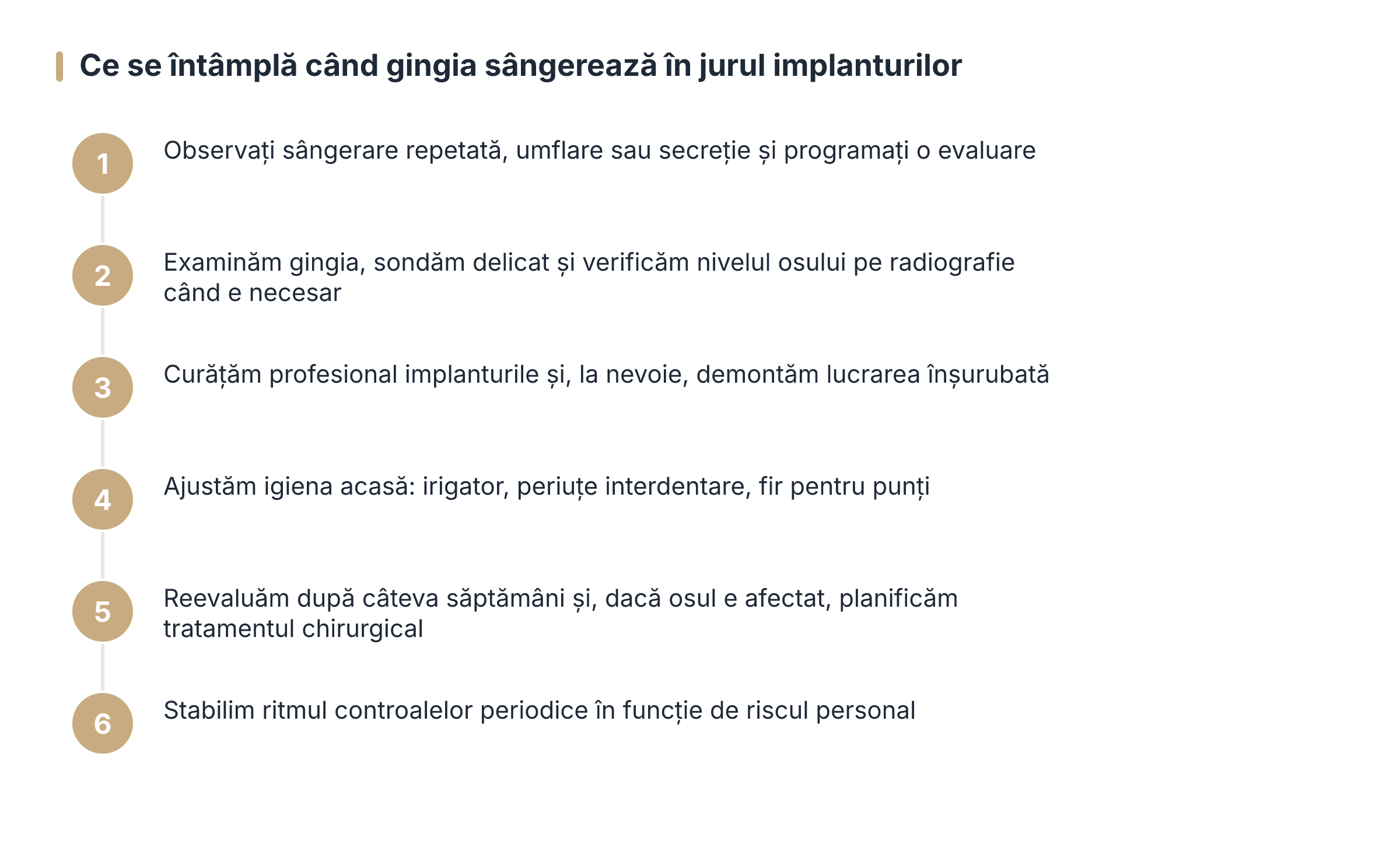
The dental implant check-up is the moment when inflammation is caught before it reaches the bone. For a patient with a fixed bridge, regular check-ups are part of the treatment, not a separate option. As a rule we recommend a visit every six months, and the interval is adapted to each patient's risk. For those with a history of periodontal disease or for smokers we often suggest more frequent check-ups.
At a routine check-up we look at:
- the appearance of the gum around each implant and whether it bleeds on gentle probing (measuring the depth of the space between gum and implant);
- the presence of plaque and tartar on the restoration and on the connecting components;
- the stability of the restoration and of the screws, and the way the bite closes;
- the bone level, on an X-ray, when the clinical signs or the time elapsed call for it.
At the check-up we also show you, on your own restoration, where plaque is left behind and how to adjust your cleaning technique. For patients coming from abroad, we schedule check-ups during the same visit as other stages, as we describe in the section on dental tourism in Cluj-Napoca.
What can be done in time: how we treat mucositis and peri-implantitis
Treatment depends on the stage of the inflammation and on how much bone has been lost. The earlier we intervene, the simpler the procedure and the better the prognosis.
Non-surgical treatment, at the mucositis stage
The first step is professional cleaning of the implants and of the restoration, with instruments compatible with the titanium surface, so as not to scratch it. With a screw-retained fixed bridge we remove the restoration when appropriate, clean the restoration and the area beneath it separately, then refit it. We correct the home hygiene technique and reassess the gum after a few weeks. In mucositis, this step is often enough for healing.
Surgical treatment, when the bone is affected
If peri-implantitis has already caused bone loss, surface cleaning no longer reaches the bacteria deeper down. The surgeon opens the gum under local anaesthesia, cleans and decontaminates the implant surface and, where the shape of the defect allows it, may attempt bone regeneration with grafting materials. You can find details about this type of procedure on the dental surgery page. When bone loss is very extensive and the implant has become loose, it may need to be removed and, after healing, a new implant placed.
Why a multidisciplinary approach matters
Peri-implantitis sits at the border between surgery, periodontology and prosthodontics. In a multidisciplinary clinic, the surgeon assesses the bone, the periodontics specialist takes care of controlling the inflammation, and the prosthodontist checks whether the restoration allows cleaning and whether the bite is not overloading any implant. Each of these elements can keep the inflammation going, so we address them together. We work with Straumann, Nobel Biocare and Bredent implant systems, and knowing exactly which components are in place helps us with maintenance and, when needed, with replacing prosthetic parts.
When to book an assessment
We recommend you do not wait for your routine check-up if you notice bleeding that recurs for several days, pus, visible gum recession, a restoration that moves or any change in the way you bite. In these situations, a prompt assessment can make the difference between a simple cleaning and a surgical procedure.
If you have implants placed at another clinic and do not know which implant system you have, bring to the consultation the documents you received during treatment and any older X-rays. They help us compare bone levels over time. You can find us on the Dental Chic contact page.
Frequently asked questions
Is it normal for the gum to bleed a little after receiving a fixed bridge on implants?
In the first days after a restoration is fitted, the gum adapts and may be sensitive, and slight bleeding during cleaning can occur. In the long term, however, a healthy gum around implants does not bleed. If bleeding continues after the healing period or returns after months of calm, it is a sign of inflammation and deserves to be assessed at a check-up. The earlier we catch it, the simpler the treatment.
Does peri-implantitis hurt?
Most of the time it does not, and that is exactly where its danger lies. The inflammation can progress for months with only bleeding, redness or an unpleasant taste, without pain. Discomfort usually appears only in advanced stages, when there is active infection or significant bone loss. So do not wait for pain as a signal; watch instead for bleeding, gum swelling and any discharge.
Can I lose the implant because of peri-implantitis?
Yes, if peri-implantitis is not treated and the bone around the implant is largely lost, the implant can become mobile and has to be removed. The good news is that, discovered in time, the inflammation can be stopped. At the mucositis stage, the gum can heal completely. Even with peri-implantitis, treatment can stabilise the situation and preserve the implant, especially when bone loss is limited.
I have had periodontal disease. Am I at higher risk of inflammation around implants?
A history of periodontal disease is one of the known risk factors for peri-implantitis, because the bacteria and the type of inflammatory response that affected the natural teeth can also act around implants. That does not mean implants are not a suitable solution for you. It means we recommend more frequent check-ups, very careful hygiene under the restoration and giving up smoking, if that applies. In this way the risk can be kept under control.
Is a water flosser enough to clean under a fixed bridge?
The water flosser is very useful for food debris and for the hard-to-reach areas under the bridge, but on its own it is not enough. Bacterial plaque sticks to surfaces and is only removed effectively by mechanical means, through friction. That is why we recommend the water flosser together with interdental brushes of the right size and, where needed, special floss for bridges. At your check-up we show you exactly where plaque remains on your restoration.
I live abroad. How often do I need to come in for implant check-ups?
As a rule we recommend a check-up every six months, and the interval is adjusted according to each patient's risk. For patients living abroad we try to group check-ups with their visits home. Between visits, if you notice repeated bleeding, pus or a restoration that moves, it is best to ask for an assessment as soon as possible, without waiting for the scheduled check-up.
This article is for information purposes only and does not replace a specialist consultation. For a diagnosis and a personalised treatment plan, please book a consultation.