

 Română
 Français
 Deutsch
 Español
 Italiano
What “too little bone for an implant” actually means
If you have been told that you do not have enough bone for an implant, this does not automatically mean that implants are out of the question. Most often it means that bone is missing in certain areas, usually at the back, and the solution depends on how much bone is left, where it is located and what type of restoration you need. For isolated missing teeth, bone grafting is often necessary. For a full arch, the tilted implants of the All-on-4 or All-on-6 concept can use the existing bone and can avoid grafting in many situations.
At our clinic we frequently see patients who come in with this conclusion from another consultation and believe that the only remaining option is a removable denture. Before any decision, it is worth understanding what was measured: the height of the bone, its width or its density. These are three different problems, with different solutions.
Why bone is lost after an extraction
The bone that supports the teeth, called alveolar bone, exists because the tooth exists. The chewing forces transmitted through the root stimulate it to maintain itself. After an extraction, this stimulus disappears and the bone begins to shrink. The phenomenon is called bone resorption after extraction and it is fastest in the first months, then continues slowly, year after year.
Resorption occurs first in width, then in height. In patients who have worn a removable denture for years, the pressure of the denture on the ridge accelerates the loss. Untreated periodontitis (gum disease that destroys the bone around the teeth) adds bone loss that begins even before the extraction.
Why the back areas are the most affected
In the upper jaw, the maxillary sinus is located at the back, an air-filled cavity that tends to drop down after the molars are lost. In the lower jaw, the inferior alveolar nerve runs at the back, providing sensation to the lip and chin. As a result, in the molar area there is often too little bone between the gum and these structures. By contrast, the front area of the jaws more often retains a usable bone volume.
What the options are: individual implants or All-on-4 / All-on-6
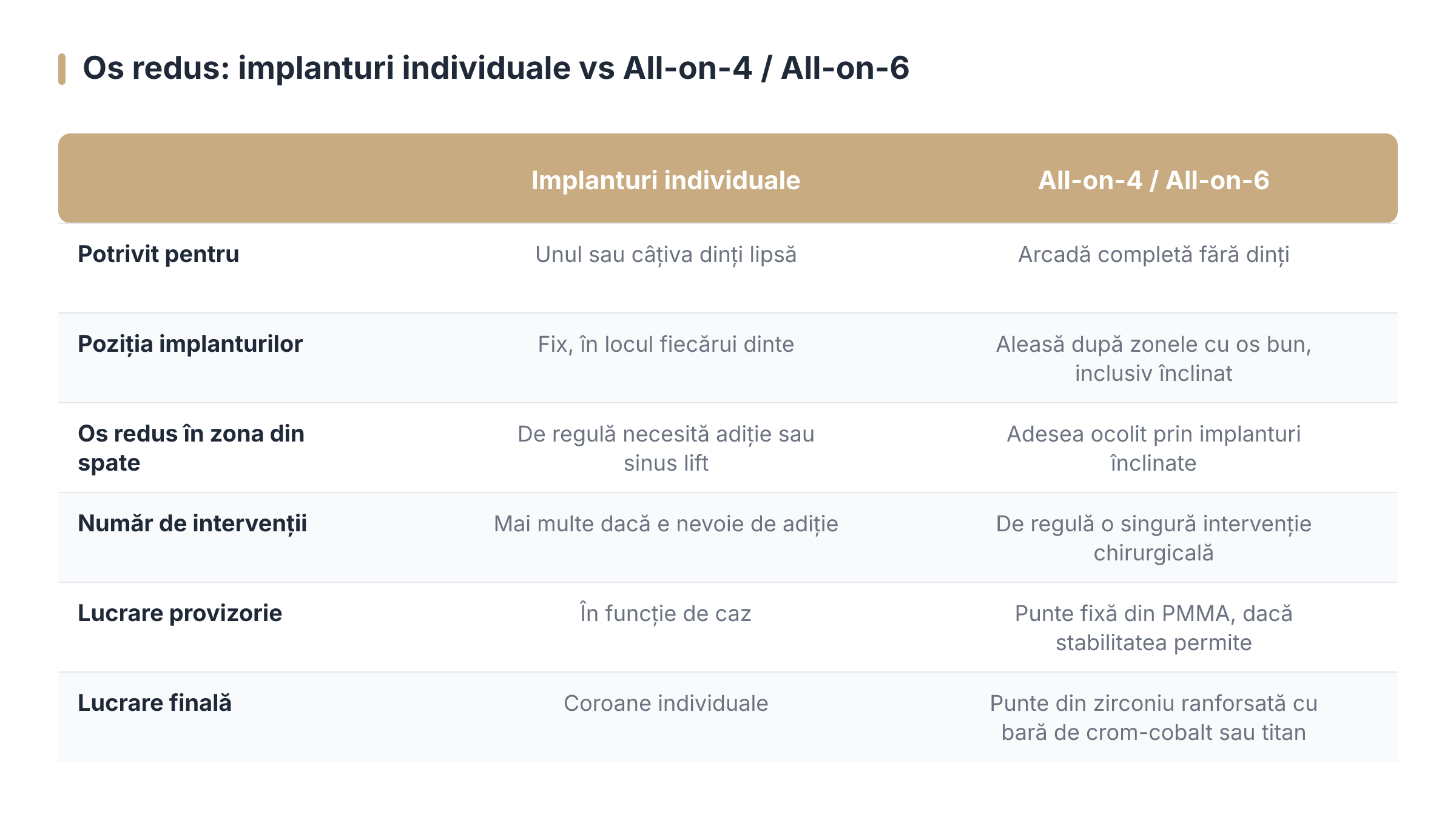
The first question is not “do I have bone or not”, but “what restoration do I need”. The answer differs considerably depending on whether you are missing two molars or all the teeth on one arch.
When one or a few teeth are missing
A single implant must be placed exactly in the position of the lost tooth, so that the future crown sits correctly in the arch. We do not have the freedom to move it to an area with better bone. If the bone there is insufficient, bone grafting for an implant (adding bone material to rebuild the volume) or a sinus lift (raising the sinus floor) is usually necessary. You can find details about these procedures on the dental surgery page.
When the entire arch is missing
Here the reasoning changes. Fixed teeth on implants of the All-on-4 or All-on-6 type do not need one implant for every tooth. The restoration is a single bridge, anchored on 4 or 6 implants, and this allows us to choose the positions according to where good-quality bone exists. The posterior implants can be placed at an angle, bypassing the sinus or the nerve, instead of having to rebuild the missing bone.
When an implant can be placed without bone grafting
The concept of tilted All-on-4 implants starts from a simple observation: if the bone at the back does not have sufficient height, we can use the bone in front of the sinus or in front of the nerve exit, angling the implant obliquely. A tilted implant has several mechanical advantages:
- it can be longer, so it has a larger contact surface with the bone;
- it anchors better, because it engages dense bone in the anterior area;
- its end emerges further back in the arch, so the bridge can have more chewing teeth that are properly supported.
All-on-6 adds two extra implants where the bone allows it, which distributes the forces over more points. We choose between 4 and 6 implants based on the bone volume, its quality and the patient's chewing force, not on a fixed rule.
In our practice, an implant without bone grafting is usually possible for a full arch when:
- the front area has sufficient height and width for the straight implants;
- there is enough bone in front of the sinus or the nerve for the tilted implants;
- the bone is dense enough for the implants to be stable from the moment of insertion (primary stability).
The benefit for the patient is tangible: fewer procedures, a shorter overall treatment period and, when stability allows it, a fixed temporary restoration made of PMMA (a durable acrylic material used only during the provisional stage) fitted shortly after surgery. We make the final restoration from zirconia, reinforced with a chrome-cobalt or titanium bar, for durability. You can see such situations in the clinical cases presented on the site.
When bone grafting or a staged approach is still needed
Tilted implants are not a universal solution, and being honest with the patient means also saying when they are not suitable. We recommend bone grafting or staged treatment in situations such as:
- isolated missing teeth, where the implant cannot be moved from the tooth position;
- severe resorption in the front area as well, when there is no longer enough volume there either for stable implants;
- a very thin ridge, where the implant would remain partially uncovered by bone;
- active infections or teeth with advanced periodontitis that need to be extracted; sometimes it is wiser to let the area heal before inserting the implants;
- bone with low density, when the implants do not achieve the stability required for immediate loading and it is safer to let them integrate before fitting the teeth.
A staged approach is not a failure of the plan, but a safety decision. An implant forced into insufficient bone can cause problems years later, and redoing it is more difficult than a graft performed in good time. In cases with periodontitis, we work together with our colleagues in periodontitis treatment, so that the tissues are healthy before surgery.
How we decide which option suits you
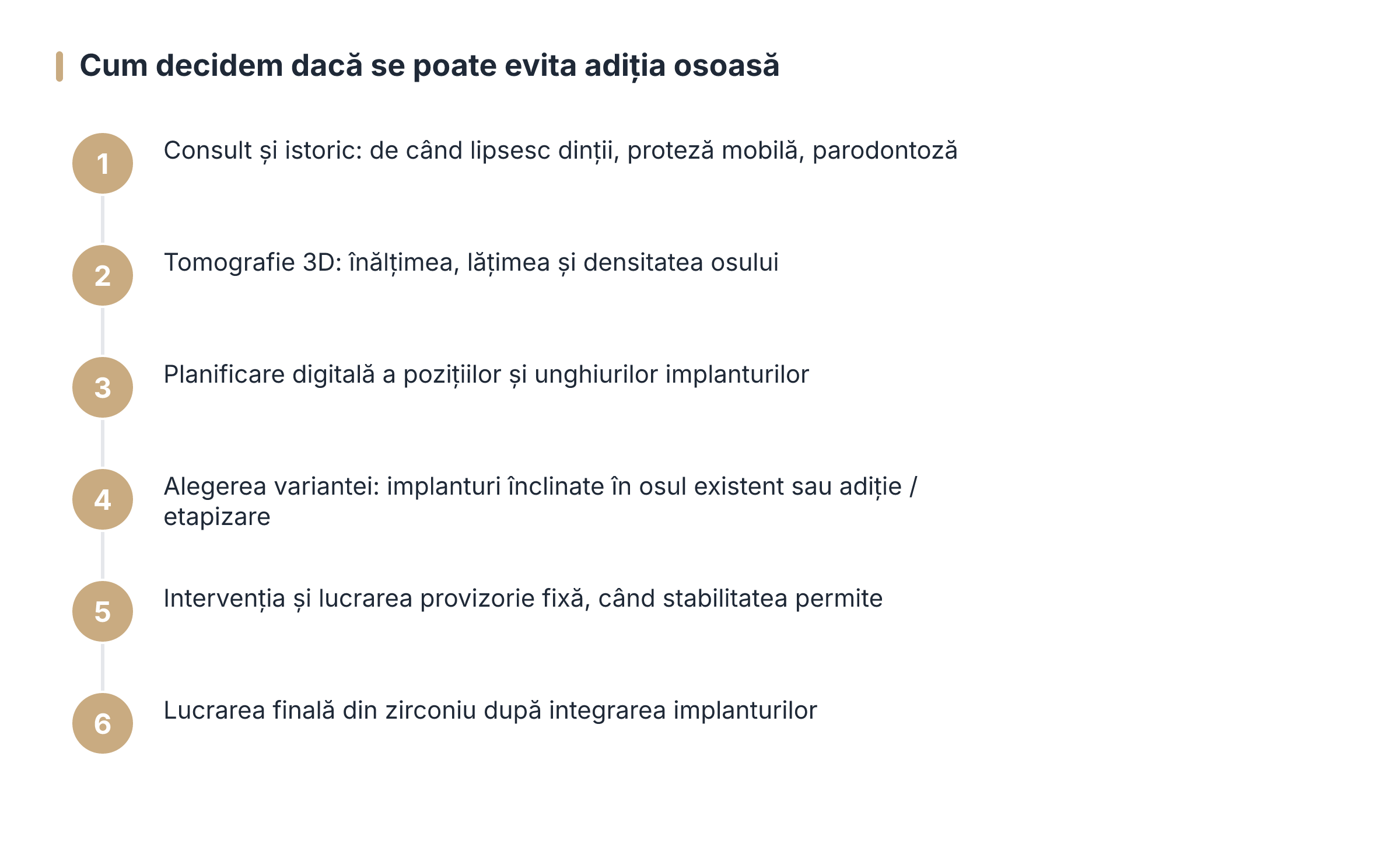
The diagnosis of “too little bone” only makes sense if it is based on a three-dimensional investigation. A panoramic X-ray shows the height of the bone, but not its width. A 3D dental scan (CBCT) shows us the thickness, the density and the exact distance to the sinus and the nerve, and on that basis we plan digitally where and at what angle each implant can be placed.
As a multidisciplinary clinic, the plan is not made by a single doctor working alone. The surgeon assesses the bone, the prosthodontist establishes how the final restoration should look and function, and if there are gum problems, the periodontist steps in. We work with Straumann, Nobel Biocare and Bredent implant systems, and the choice of system also depends on the type of bone and on the surgical plan.
What to ask at your consultation
- Where exactly is bone missing: in height, in width or in density?
- For the restoration I need, can the implants be positioned in the existing bone?
- If grafting is necessary, why, and how much longer will the treatment take?
- Can I have fixed temporary teeth straight away, or do I have to wait for the implants to integrate?
- What are the alternatives, including individual implants compared with All-on-4 or All-on-6?
If you have already received a plan that includes grafting and you are wondering whether there is another way, a second assessment based on the same scan is a reasonable step. You can find out more about our approach on the implantology page.
Frequently asked questions
If I have too little bone, can I still have fixed teeth?
In many cases, yes. For a full arch, the All-on-4 and All-on-6 concepts use tilted implants in the areas where bone has been preserved, usually at the front and in front of the sinus or the nerve. This way, many patients with reduced bone at the back can receive fixed teeth without bone reconstruction. The decision is only made after a 3D scan, which shows exactly how much bone there is and where. If resorption is severe in the anterior area as well, grafting or staged treatment may be necessary.
Are tilted implants as strong as straight ones?
Tilted implants are a planned technique, not a compromise. Because they can be longer and anchor in denser bone, they provide solid support for the bridge. The bridge rigidly connects all the implants to one another, and the chewing forces are distributed across the entire structure. The angle and position of each implant are established during digital planning, according to each patient's anatomy. Careful hygiene and regular check-ups matter just as much as with any other type of implant.
How soon after an extraction does bone loss begin?
Bone resorption begins immediately after the extraction and is most pronounced in the first months, when the ridge narrows visibly. The process then continues more slowly, year after year, especially if the area remains without a tooth or a removable denture that presses on the ridge is worn. That is why we recommend discussing the implant plan as close as possible to the time of the extraction. Sometimes implants can be inserted during the very same session, if there is no active infection.
Does bone grafting hurt and how much longer does it make the treatment?
Bone grafting is performed under local anaesthesia, and the discomfort afterwards, such as swelling or tenderness, is usually controlled with the recommended medication. What really extends the treatment is the healing period: the added bone needs a few months to integrate before the implants can be loaded. The exact duration depends on the volume reconstructed and the area treated, so we discuss it individually during planning.
Can I have only individual implants instead of All-on-4, even if I have little bone?
It is possible, but usually with more procedures. Individual implants have to be placed exactly in the position of each tooth, so in the back areas with reduced bone, bone grafting or a sinus lift will be necessary. For patients who have lost all the teeth on one arch, All-on-4 or All-on-6 use fewer implants, positioned strategically in the existing bone. At the consultation we compare both options, with the duration, the number of procedures and the maintenance each one involves.
This article is for information purposes only and does not replace a specialist consultation. For a diagnosis and a personalised treatment plan, please book an appointment.